SpecForge User Guide
SpecForge is an AI-powered formal specification authoring tool based on Lilo, a domain specific language designed for specifying temporal systems.
This guide covers installation, the Lilo specification language, the Python SDK, and using Lilo with VSCode.
To get started, see setting up, releases are available from the releases page. A few example projects can be found in the examples repository or be downloaded from the releases page.
Other versions of this guide:
- In PDF format.
- In Japanese. (このガイドには日本語版もあります.)
You are reading the docs for version 0.5.8 of SpecForge. Navigate to a different URL to view docs for a different version.
Setting up SpecForge
The SpecForge suite consists of a few components:
- The SpecForge Server which is the backend server which the other components connect to. It can be run via Docker or as an executable.
- The SpecForge VSCode Extension which provides Lilo Language support in VSCode for editing and managing specifications, as well as rendering interactive visualizations.
- The SpecForge Python SDK which provides an API for interacting with the SpecForge server from Python code. This can be used to communicate and exchange specifications or data with the SpecForge server from Python scripts or Jupyter notebooks.
All necessary files can be obtained from the SpecForge releases page.
Quick Start
Follow these steps to get started quickly:
- Install dependencies
z3andrsvg-converter(see OS-specific instructions;rsvg-converteris optional) - Download and extract the SpecForge executable for your operating system
- Configure your license (place
license.jsonin the appropriate location for your OS) - (Optional) Configure LLM provider by setting environment variables (e.g.,
SPECFORGE_LLM_PROVIDER=openai,OPENAI_API_KEY=...) - see LLM Provider Configuration - Start the SpecForge server:
./specforge serve(or.\specforge.exe serveon Windows) - Install the VSCode Extension (see docs)
- Create a directory for your project and place your
.lilofiles directly in it - Open the directory in VSCode and start writing specifications
Note: The lilo.toml project configuration file is optional. For initial setup, you can skip it and place your specification and data files directly in the project root. See Project Configuration for details on when and how to use lilo.toml.
Detailed Setup Instructions
Choose your platform for detailed setup instructions:
- Windows - Complete setup guide for Windows
- macOS - Complete setup guide for macOS (Apple Silicon)
- Linux - Complete setup guide for Linux
- Docker - Using Docker instead of the executable
Server Environment Variables
The SpecForge server reads the following environment variables at startup. These can be set before running specforge serve or configured in your Docker Compose file.
| Variable | Type | Default | Description |
|---|---|---|---|
SPECFORGE_PORT | Integer | 8080 | Port the server listens on. |
SPECFORGE_CACHE_BOUND | Integer | 64 | Maximum number of entries in the exemplification cache. The cache stores results from the SMT solver (Z3) to avoid redundant computations. Set to 0 to disable caching. |
SPECFORGE_SEMAPHORE_LIMIT | Integer | 8 | Maximum number of concurrent SMT solver (Z3) instances. Limits parallelism to prevent resource exhaustion. Set to 0 to disable the semaphore (no concurrency limit). |
Example usage:
SPECFORGE_PORT=9090 SPECFORGE_CACHE_BOUND=128 ./specforge serve
For LLM-related environment variables (SPECFORGE_LLM_PROVIDER, SPECFORGE_LLM_MODEL, OPENAI_API_KEY, etc.), see the LLM Provider Configuration guide.
Note that all of these can also be configured in the settings of the SpecForge VSCode extension.
Setting up SpecForge on Windows
This guide will walk you through setting up SpecForge on Windows.
1. Installation
MSI Installer (Recommended)
Download specforge-x.y.z-Windows-X64-en-US.msi from the SpecForge releases page and run the installer.
The MSI installer will:
- Install SpecForge to
C:\Program Files\Imiron\SpecForge\ - Add SpecForge to your system PATH automatically
- Include all required dependencies (Z3, rsvg-convert)
Standalone Executable
Download specforge-x.y.z-Windows-X64.zip from the SpecForge releases page and extract it to a directory of your choice.
Note: With this method, you need to manually install dependencies.
The SpecForge executable requires Z3 and rsvg-converter (optional) to be installed on your system.
Using Chocolatey (Recommended)
Open PowerShell as Administrator and run:
choco install z3 rsvg-convert
If you don’t have Chocolatey, you can install it from chocolatey.org.
Manual Installation
If you prefer not to use a package manager, download Z3 directly from the Z3 releases page and add it to your PATH.
2. Configure Your License
The SpecForge server requires a valid license file to start. If you don’t have a license, please contact the SpecForge team or request a trial license.
Place your license.json file in one of the following locations:
-
Standard Configuration Directory (recommended):
%APPDATA%\specforge\license.json- Typically:
C:\Users\YourUsername\AppData\Roaming\specforge\license.json
-
Environment Variable (for custom locations):
$env:SPECFORGE_LICENSE_FILE="C:\path\to\license.json" -
Current Directory:
.\license.json
Create the directory if it doesn’t exist. You can do this in PowerShell:
New-Item -ItemType Directory -Force -Path "$env:APPDATA\specforge"
Copy-Item "C:\path\to\your\license.json" "$env:APPDATA\specforge\license.json"
3. Configure LLM Provider (Optional)
To use LLM-based features such as natural-language spec generation and error explanation, configure an LLM provider by setting environment variables before starting the server.
For OpenAI (recommended):
$env:SPECFORGE_LLM_PROVIDER="openai"
$env:SPECFORGE_LLM_MODEL="gpt-5-nano-2025-08-07"
$env:OPENAI_API_KEY="your-api-key-here"
Get an API key from platform.openai.com/api-keys.
For other providers (Gemini, Anthropic, Ollama), see the LLM Provider Configuration guide.
4. Start the Server
If you used the MSI installer, run from any directory:
specforge serve
If you used the standalone executable, navigate to the directory where you extracted the SpecForge executable and run:
.\specforge.exe serve
The server will start on http://localhost:8080. You can verify it’s running by navigating to http://localhost:8080/health, which should show version information.
Note: The server will exit immediately if the license is missing or invalid. If you encounter startup issues, verify your license configuration.
5. Install the VSCode Extension
Install the SpecForge VSCode extension from the Visual Studio Marketplace or see the VSCode Extension setup guide.
6. Install the Python SDK (Optional)
The Python SDK enables interaction with the SpecForge server programmatically from Python. This can be used to embed SpecForge analyses in Python notebooks and directly feed and retrieve data using Pandas Dataframes. See the Python SDK setup guide for instructions on how to set it up.
Further Reading
- VSCode Extension - Learn about the VSCode extension features
- Python SDK - Set up the Python SDK for programmatic access
- A Whirlwind Tour - Take a tour of SpecForge capabilities
- Project Configuration - Learn about
lilo.tomlconfiguration
Setting up SpecForge on macOS
This guide will walk you through setting up SpecForge on macOS using the standalone executable.
1. Download the Executable
Download specforge-x.y.z-macOS-ARM64.tar.bz2 from the SpecForge releases page and extract it to a directory of your choice.
2. Install Dependencies
The SpecForge executable requires Z3 to be installed. rsvg-converter is optional but recommended for SVG-to-PNG conversion used by the animation feature.
Install using Homebrew:
brew install z3 librsvg
If you don’t have Homebrew, install it from brew.sh.
Note:
librsvgprovides thersvg-convertcommand. Without it, theanimate()feature in the Python SDK will not be able to render PNG frames from SVG visualizations. All other SpecForge features work without it.
3. Configure Your License
The SpecForge server requires a valid license file to start. If you don’t have a license, please contact the SpecForge team or request a trial license.
Place your license.json file in one of the following locations:
-
Standard Configuration Directory (recommended):
~/.config/specforge/license.json
-
Environment Variable (for custom locations):
export SPECFORGE_LICENSE_FILE=/path/to/license.json -
Current Directory:
./license.json
Create the directory if it doesn’t exist:
mkdir -p ~/.config/specforge
cp /path/to/your/license.json ~/.config/specforge/
4. Configure LLM Provider (Optional)
To use LLM-based features such as natural-language spec generation and error explanation, configure an LLM provider by setting environment variables before starting the server.
For OpenAI (recommended):
export SPECFORGE_LLM_PROVIDER=openai
export SPECFORGE_LLM_MODEL=gpt-5-nano-2025-08-07
export OPENAI_API_KEY=your-api-key-here
Get an API key from platform.openai.com/api-keys.
For other providers (Gemini, Anthropic, Ollama), see the LLM Provider Configuration guide.
5. Start the Server
Navigate to the directory where you extracted the SpecForge executable and run:
./specforge serve
The server will start on http://localhost:8080. You can verify it’s running by navigating to http://localhost:8080/health, which should show version information.
Note: The server will exit immediately if the license is missing or invalid. If you encounter startup issues, verify your license configuration.
Allowing Execution of the Downloaded SpecForge Binary
The MacOS Gatekeeper may display an alert preventing you from executing the downloaded binary, because it was downloaded from a third-party source.
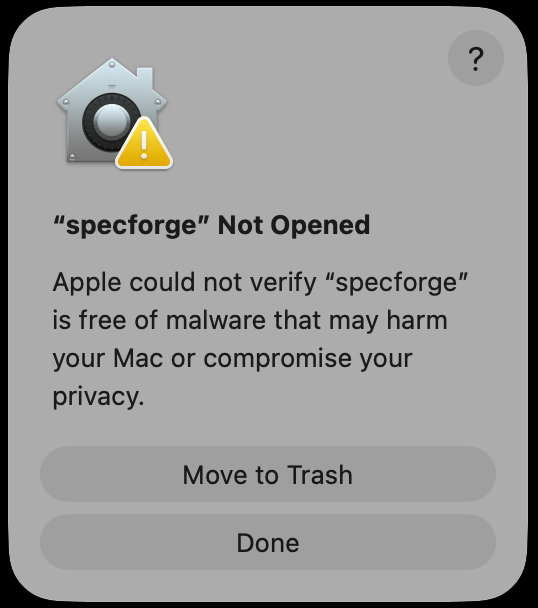
To whitelist the specforge executable, run the following command.
xattr -d com.apple.quarantine path/to/specforge
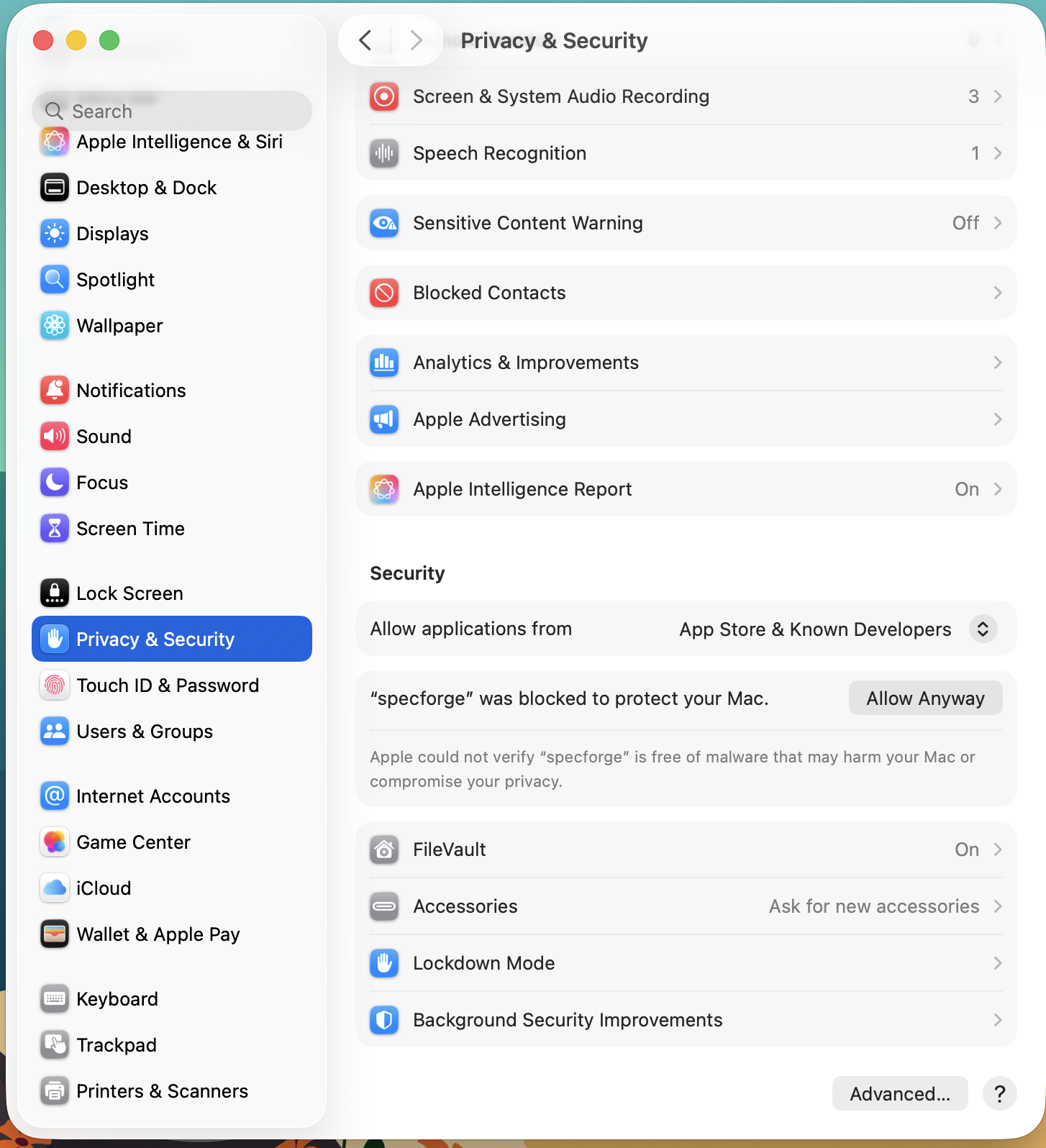
Alternatively, you can do so from the System Settings GUI by following these steps.
- Open System Settings, and go to ‘Privacy & Security’
- In the security section, you should see ‘“specforge” was blocked to protect your Mac.’
- Click ‘Open Anyway’.
6. Install the VSCode Extension
Install the SpecForge VSCode extension from the Visual Studio Marketplace or see the VSCode Extension setup guide.
7. Install the Python SDK (Optional)
The Python SDK enables interaction with the SpecForge server programmatically from Python. This can be used to embed SpecForge analyses in Python notebooks and directly feed and retrieve data using Pandas Dataframes. See the Python SDK setup guide for instructions on how to set it up.
Further Reading
- VSCode Extension - Learn about the VSCode extension features
- Python SDK - Set up the Python SDK for programmatic access
- A Whirlwind Tour - Take a tour of SpecForge capabilities
- Project Configuration - Learn about
lilo.tomlconfiguration
Setting up SpecForge on Linux
This guide will walk you through setting up SpecForge on Linux using the standalone executable.
1. Download the Executable
Download specforge-x.y.z-Linux-X64.tar.bz2 from the SpecForge releases page and extract it to a directory of your choice.
2. Install Dependencies
The SpecForge executable requires Z3 to be installed. rsvg-converter is optional but recommended for SVG-to-PNG conversion used by the animation feature.
Use your distribution’s package manager:
Ubuntu/Debian:
sudo apt install z3 librsvg2-bin
Fedora/RHEL:
sudo dnf install z3 librsvg2-tools
Arch Linux:
sudo pacman -S z3 librsvg
Note: The
librsvg2-bin/librsvg2-tools/librsvgpackage provides thersvg-convertcommand. Without it, theanimate()feature in the Python SDK will not be able to render PNG frames from SVG visualizations. All other SpecForge features work without it.
3. Configure Your License
The SpecForge server requires a valid license file to start. If you don’t have a license, please contact the SpecForge team or request a trial license.
Place your license.json file in one of the following locations:
-
Standard Configuration Directory (recommended):
~/.config/specforge/license.json
-
Environment Variable (for custom locations):
export SPECFORGE_LICENSE_FILE=/path/to/license.json -
Current Directory:
./license.json
Create the directory if it doesn’t exist:
mkdir -p ~/.config/specforge
cp /path/to/your/license.json ~/.config/specforge/
4. Configure LLM Provider (Optional)
To use LLM-based features such as natural-language spec generation and error explanation, configure an LLM provider by setting environment variables before starting the server.
For OpenAI (recommended):
export SPECFORGE_LLM_PROVIDER=openai
export SPECFORGE_LLM_MODEL=gpt-5-nano-2025-08-07
export OPENAI_API_KEY=your-api-key-here
Get an API key from platform.openai.com/api-keys.
For other providers (Gemini, Anthropic, Ollama), see the LLM Provider Configuration guide.
5. Start the Server
Navigate to the directory where you extracted the SpecForge executable and run:
./specforge serve
The server will start on http://localhost:8080. You can verify it’s running by navigating to http://localhost:8080/health, which should show version information.
Note: The server will exit immediately if the license is missing or invalid. If you encounter startup issues, verify your license configuration.
6. Install the VSCode Extension
Install the SpecForge VSCode extension from the Visual Studio Marketplace or see the VSCode Extension setup guide.
7. Install the Python SDK (Optional)
The Python SDK enables interaction with the SpecForge server programmatically from Python. This can be used to embed SpecForge analyses in Python notebooks and directly feed and retrieve data using Pandas Dataframes. See the Python SDK setup guide for instructions on how to set it up.
Further Reading
- VSCode Extension - Learn about the VSCode extension features
- Python SDK - Set up the Python SDK for programmatic access
- A Whirlwind Tour - Take a tour of SpecForge capabilities
- Project Configuration - Learn about
lilo.tomlconfiguration
Setting up SpecForge with Docker
This guide will walk you through setting up SpecForge using Docker instead of the standalone executable.
Prerequisites
Before starting the server, you must obtain and configure a valid license. If you don’t have a license, please contact the SpecForge team or request a trial license.
1. Obtain the Docker Compose File
The SpecForge Server is distributed as a Docker Image via GHCR (GitHub Container Registry). The recommended way to run the Docker Image is through Docker Compose.
Download the latest docker-compose-x.y.z.yml file from the SpecForge releases page.
2. Configure Your License
The SpecForge server requires a valid license file. You need to make the license file available to the Docker container.
-
Place your
license.jsonfile in a new directory. Using/home/user/.config/specforge/is a common practice. -
Modify the following lines in your
docker-compose-x.y.z.ymlfile to point to your license file:- type: bind source: path/to/.config/specforge/ # place your license.json file here on the host machine target: /app/specforgeconfig/ # config directory inside the container (do not modify this) read_only: trueNote: It is not recommended to run docker as
root(i.e. withsudo). But if you do, note that paths with~/would be understood by the system as/root/, not your home directory. So it’s best to use absolute paths (without~).
3. Configure LLM Provider (Optional)
To use LLM-based features such as natural-language spec generation and error explanation, configure an LLM provider by modifying environment variables in your docker-compose.yml file before starting the server.
For OpenAI (recommended):
- SPECFORGE_LLM_PROVIDER=openai
- SPECFORGE_LLM_MODEL=gpt-5-nano-2025-08-07
- OPENAI_API_KEY=${OPENAI_API_KEY}
Get an API key from platform.openai.com/api-keys.
You can insert API keys directly in the file, but using environment variables is better for security.
For other providers (Gemini, Anthropic, Ollama) and detailed configuration options, see the LLM Provider Configuration guide.
4. Start the Server
Run the following command, replacing /path/to/docker-compose-x.y.z.yml with the actual path to your downloaded file:
docker compose -f /path/to/docker-compose-x.y.z.yml up --abort-on-container-exit
The flag
--abort-on-container-exitis recommended so that the container fails fast on startup errors.
You can verify that the server is up by navigating to http://localhost:8080/health, which should show version information.
Note: The server will exit immediately if the license is missing or invalid. If you encounter startup issues, verify your license configuration.
5. Install the VSCode Extension
Install the SpecForge VSCode extension from the Visual Studio Marketplace or see the VSCode Extension setup guide.
Updating the Docker Image
From time to time, new versions of the SpecForge Server are released. To use the latest version, you can either:
-
Use the updated docker-compose file from the releases page, or
-
Set the image field to latest in your Docker Compose file:
image: ghcr.io/imiron-io/specforge/specforge-backend:latestThen pull the latest image:
docker compose -f /path/to/docker-compose.yml pull
Next Steps
- VSCode Extension - Learn about the VSCode extension features
- Python SDK - Set up the Python SDK for programmatic access
- A Whirlwind Tour - Take a tour of SpecForge capabilities
- Project Configuration - Learn about
lilo.tomlconfiguration
LLM Provider Configuration
SpecForge includes LLM-based features such as natural-language based spec generation and error explanation. To use these features, you need to configure an LLM provider.
Supported Providers
SpecForge currently supports three LLM providers:
- OpenAI - Cloud-based API (recommended for most users)
- Gemini - Google’s cloud-based API
- Ollama - Run models locally on your machine
Configuration Methods
For Executable (Windows, macOS, Linux)
Set the following environment variables before starting the SpecForge server:
OpenAI
# Linux / macOS
export SPECFORGE_LLM_PROVIDER=openai
export SPECFORGE_LLM_MODEL=gpt-5-nano-2025-08-07
export OPENAI_API_KEY=your-api-key-here
# Windows PowerShell
$env:SPECFORGE_LLM_PROVIDER="openai"
$env:SPECFORGE_LLM_MODEL="gpt-5-nano-2025-08-07"
$env:OPENAI_API_KEY="your-api-key-here"
Get an API key from platform.openai.com/api-keys.
Gemini
# Linux / macOS
export SPECFORGE_LLM_PROVIDER=gemini
export SPECFORGE_LLM_MODEL=gemini-2.5-flash
export GEMINI_API_KEY=your-api-key-here
# Windows PowerShell
$env:SPECFORGE_LLM_PROVIDER="gemini"
$env:SPECFORGE_LLM_MODEL="gemini-2.5-flash"
$env:GEMINI_API_KEY="your-api-key-here"
Get an API key from ai.google.dev/gemini-api/docs/api-key.
Anthropic
# Linux / macOS
export SPECFORGE_LLM_PROVIDER=anthropic
export SPECFORGE_LLM_MODEL=claude-haiku-4-5
export ANTHROPIC_API_KEY=your-api-key-here
# Windows PowerShell
$env:SPECFORGE_LLM_PROVIDER="anthropic"
$env:SPECFORGE_LLM_MODEL="claude-haiku-4-5"
$env:ANTHROPIC_API_KEY="your-api-key-here"
Get an API key from platform.claude.com/docs/en/api/admin/api_keys/retrieve.
Ollama
First, install and run Ollama from docs.ollama.com/quickstart.
Then set the environment variables:
# Linux / macOS
export SPECFORGE_LLM_PROVIDER=ollama
export SPECFORGE_LLM_MODEL=your-model-name  # e.g., llama3.2, mistral
export OLLAMA_API_BASE=http://127.0.0.1:11434
# Windows PowerShell
$env:SPECFORGE_LLM_PROVIDER="ollama"
$env:SPECFORGE_LLM_MODEL="your-model-name"  # e.g., llama3.2, mistral
$env:OLLAMA_API_BASE="http://127.0.0.1:11434"
Change OLLAMA_API_BASE if your Ollama server is running on a different machine.
For Docker
Modify the environment variables in your docker-compose.yml file:
- SPECFORGE_LLM_PROVIDER=openai # other options: ollama, gemini
- SPECFORGE_LLM_MODEL=gpt-5-nano-2025-08-07 # choose the appropriate model for your provider
# One of the following, depending on SPECFORGE_LLM_PROVIDER:
- OPENAI_API_KEY=${OPENAI_API_KEY}
- GEMINI_API_KEY=${GEMINI_API_KEY}
- OLLAMA_API_BASE=http://127.0.0.1:11434 # change if your ollama server is running remotely
You can insert API keys directly in the file:
- SPECFORGE_LLM_PROVIDER=gemini
- GEMINI_API_KEY=abc123XYZ # no string quotes
However, it is better to use environment variables for security.
Default Models
If you don’t set the SPECFORGE_LLM_MODEL variable:
- OpenAI: Defaults to
gpt-5-nano-2025-08-07 - Gemini: Defaults to
gemini-2.5-flash - Anthropic: Defaults to
claude-haiku-4-5 - Ollama: You must specify a model (no default)
Without LLM Configuration
Without an appropriate LLM provider configuration, LLM-based SpecForge features will be unavailable. The rest of SpecForge will continue to work normally.
VSCode Extension
The Lilo Language Extension for VSCode provides
- Syntax Highlighting, Typechecking and Autocompletion for
.lilofiles - Satisfiability and Redundancy checking for specifications
- Support for visualizing monitoring results in Python notebooks
Installation
The SpecForge VSCode extension can be installed in two ways:
From the VSCode Marketplace
Install the extension directly from the Visual Studio Marketplace or search for “SpecForge” in VSCode’s extensions tab (Ctrl+Shift+X or Cmd+Shift+X).
From VSIX File
Alternatively, you can install from a VSIX file (included in releases):
- Open VSCode’s extensions tab (Ctrl+Shift+X or Cmd+Shift+X), click on the three dots at the top right, and select
Install from VSIX... - Open VSCode’s command palette (Ctrl+Shift+P or Cmd+Shift+P), type
Extensions: Install from VSIX..., and select the.vsixfile
Important: Ensure the extension version matches your SpecForge server version. Version mismatches may cause compatibility issues.
Usage and Configuration
For the extension to work, the SpecForge server must be accessible. There are two ways to connect:
-
Managed server (
specforge.spawnServer): Enable this setting and the extension will start and manage the SpecForge server process for you. Configurespecforge.serverPathif thespecforgebinary is not on yourPATH, andspecforge.preferredPortto choose a port. -
External server (default): Run the SpecForge server yourself (see Setting up SpecForge) and point the extension at it using the
specforge.apiBaseUrlsetting (default:http://localhost:8080).
Once the extension is installed and the server is running, it should automatically be working on .lilo files, and in relevant Python notebooks.
The VSCode workspace should be a directory which contains a specific lilo project. The extension will use the lilo.toml file at the root of the workspace to determine certain details about the project. Refer to the Python SDK setup guide to see an example of a project structure.
For a full reference of all available settings (LLM integration, server tuning, tracing, etc.), see the Configuration section of the VSCode Extension guide.
Setting up the Python SDK
The Python SDK is a python library which can be used to interact with SpecForge tools programmatically from within Python programs, including notebooks.
The Python SDK is packaged as a wheel file with the name specforge_sdk-x.x.x-py3-none-any.whl.
Refer to the SpecForge Python SDK guide for an overview of the SDK features and capabilities.
A Sample Walkthrough
The Python SDK can be installed directly using pip, or defined as a dependency via a build envionment such as poetry or uv.
We discuss below how such an environment can be setup using uv. If you prefer to use a different build system, the workflow should be similar.
The recommended way to use uv is to set up a pyproject.toml file for each project separately. This would allow you to manage dependencies on a per-project basis, and avoid conflicts between different projects. Here is what a typical directory structure would look like:
sample_project
├── data
│   ├── first60.csv
│   ├── last60.csv
│   └── sampled.csv
├── lib
│   └── specforge_sdk-0.5.7-py3-none-any.whl
├── scripts
│   └── script.py
├── .venv
│   └── (managed by uv)
├── lilo.toml
├── explore.ipynb
├── main.lilo
├── pyproject.toml
└── uv.lock
-
Install
uvon your operating system. See the uv installation guide for more details. -
Create a new project directory and navigate into it. Populate it with a
pyproject.tomlfile. -
Declare the dependencies in the
pyproject.tomlfile.- The wheel file for the Python SDK can be declared as a local dependency. Ensure that a correct path to the wheel file is provided.
- Features of SpecForge, such as the interactive monitor, can be used as a part of Python Notebooks. To do so, you may want to include
jupyterlabas a dependency as well. - Libraries such as
numpy,pandasandmatplotlibare frequently included for data processing and visualization. - Here is an example
pyproject.tomlfile:
[project] name = "sample-project" version = "0.1.0" description = "Sample Project for Testing SpecForge SDK" authors = [{ name = "Imiron Developers", email = "info@imiron.io" }] readme = "README.md" requires-python = ">=3.12" dependencies = [ "jupyterlab>=4.4.5", "pandas>=2.3.1", "matplotlib>=3.10.3", "numpy>=2.3.2", "specforge-sdk", ] [tool.uv.sources] specforge_sdk = { path = "lib/specforge_sdk-0.5.8-py3-none-any.whl" } -
Run
uv sync. This should create a.venvdirectory which would have the appropriate dependencies (including the correct version of python) installed.- Note that this
.venvis unique to this project. Each project should have its own.venvdirectory, meaning that there should be a separatepyproject.tomlfile for each project, and you would have to runuv syncfor each project separately.
- Note that this
-
Run
source .venv/bin/activateto use the Shell Hook with access topython. You can confirm that this has been configured correctly as follows.$ source .venv/bin/activate (sample-project) $ which python /path/to/project/sample-project/.venv/bin/python -
Now, you can browse the example notebooks. Make sure that your notebook is connected to the kernel in the
.venv. This is usually configured automatically, but can also be done manually. To do so, runjupyter serverand copy and paste the server URL in the kernel settings in the VSCode notebook viewer.
Project Configuration
Lilo projects can use an optional lilo.toml configuration file at the project root.
For getting started, you can skip this configuration entirely and simply place your .lilo specification files and data files directly in the root of your project. SpecForge will work with sensible defaults.
When you do use lilo.toml, if the file or any of its fields are missing, sensible defaults apply. The Python SDK and the VS Code extension read this file and apply the semantics accordingly.
The configuration file is useful for:
- Setting a project name and custom source path (default: project root or
src/) - Customizing language behavior (interval mode, freeze)
- Adjusting diagnostics settings (consistency, redundancy, optimize, unused defs) and their timeouts
- Registering
system_falsifierentries for falsification analysis
Below are the schema and defaults, followed by a complete example.
Schema and defaults
Top-level keys and their defaults when omitted:
-
projectname(string).- Default:
"". - On init: set to the provided name; otherwise to the name of the project root directory.
- Default:
source(path string). Default:"src/"
-
languageinterval.mode(string). Supported:"static". Default:"static"freeze.enabled(bool). Default:true
-
diagnosticsconsistency.enabled(bool). Default:trueconsistency.timeouts— SMT solver timeouts for consistency checks:named(seconds, float). Timeout per individual named specification. Default:0.5system(seconds, float). Timeout for the whole-system consistency check (all specs checked together). Default:1.0
redundancy.enabled(bool). Default:trueredundancy.timeouts— SMT solver timeouts for redundancy checks:named(seconds, float). Timeout per individual named specification. Default:0.5system(seconds, float). Timeout for the whole-system redundancy check (all specs checked together). Default:1.0
optimize.enabled(bool). Default:trueunused_defs.enabled(bool). Default:true
-
[[system_falsifier]](array of tables, optional)- Each entry:
name(string),system(string),script(string) - If absent or empty, the key is omitted from the file and treated as an empty list
- Each entry:
Default file:
[project]
name = ""
source = "src/"
Example lilo.toml
An example project with overrides.
[project]
name = "my-specs"
source = "src/"

[language]
freeze.enabled = true
interval.mode = "static"

[diagnostics.consistency]
enabled = true

[diagnostics.consistency.timeouts]
named = 5.0
system = 10.0

[diagnostics.optimize]
enabled = true

[diagnostics.redundancy]
enabled = false

[diagnostics.unused_defs]
enabled = false

[[system_falsifier]]
name = "Psitaliro ClimateControl Falsifier"
system = "climate_control"
script = "falsifiers/falsify_climate_control.py"

[[system_falsifier]]
name = "Psitaliro ALKS falisifier"
system = "lane_keeping"
script = "falsifiers/alks.py"
A Whirlwind Tour
This section is a quick introduction to SpecForge’s main capabilities through a hands-on example. We’ll explore how to write specifications in the Lilo language and analyze them using SpecForge’s VSCode extension.
The Lilo Language: A Brief Introduction
Lilo is an expression-based temporal specification language designed for hybrid systems. Here are the key concepts:
Primitive Types: Bool, Int, Float, and String
Operators: Standard arithmetic (+, -, *, /), comparisons (==, <, >, etc.), and logical operators (&&, ||, =>)
Temporal Operators: Lilo’s distinguishing feature is its rich set of temporal logic operators:
always φ:φis true at all future timeseventually φ:φis true at some future timepast φ:φwas true at some past timehistorically φ:φwas true at all past times
These operators can be qualified with time intervals, e.g., eventually[0, 10] φ means φ becomes true within 10 time units. More operators are available.
Systems: Lilo specifications are organized into systems that group together:
signals: Time-varying input values (e.g.,signal temperature: Float)params: Non-temporal parameters that are not time-varying (e.g.,param max_temp: Float)types: Custom types for structured datadefinitions: Reusable definitions and helper functionsspecifications: Requirements that should hold for the system
A system file begins with a system declaration like system temperature_control and contains all the declarations for that system.
For a comprehensive guide to the language, see the Lilo Language chapter.
Running Example
We’ll use a temperature control system as our running example. This example project is available in the releases. The system monitors temperature and humidity sensors, with specifications ensuring values remain within safe ranges:
system temperature_sensor

// Temperature Monitoring specifications
// This spec defines safety requirements for a temperature sensor system

import util use { in_bounds }

signal temperature: Float
signal humidity: Float

param min_temperature: Float
param max_temperature: Float

#[disable(redundancy)]
spec temperature_in_bounds = in_bounds(temperature, min_temperature, max_temperature)

spec always_in_bounds = always temperature_in_bounds

// Humidity should be reasonable when temperature is in normal range
spec humidity_correlation = always (
  (temperature >= 15.0 && temperature <= 35.0) =>
  (humidity >= 20.0 && humidity <= 80.0)
)

// Emergency condition - temperature exceeds critical thresholds
spec emergency_condition = temperature < 5.0 || temperature > 45.0

// Recovery specification - after emergency, system should stabilize
spec recovery_spec = always (
  emergency_condition =>
  eventually[0, 10] (temperature >= 15.0 && temperature <= 35.0)
)
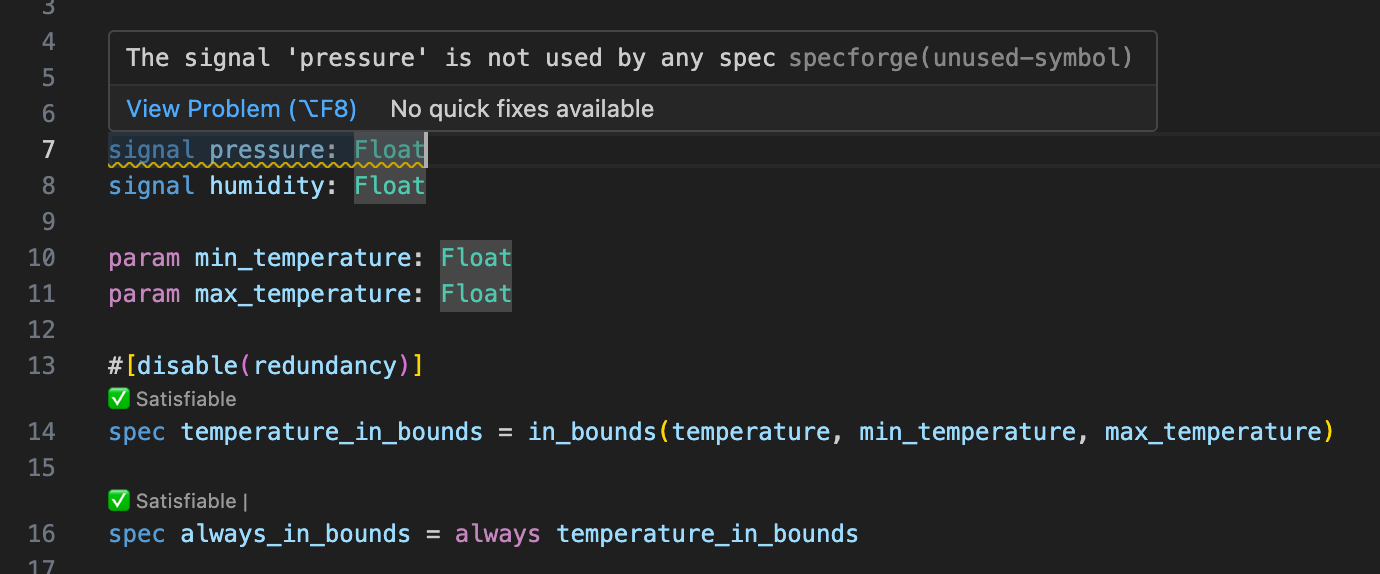
The VSCode extension provides support for writing Lilo code, syntax highlighting, type-checking, warnings, spec satisfiability, etc.:
Spec Analysis
Once you’ve written specifications for your system, the SpecForge VSCode extension provides various analysis capabilities:
- Monitor: Check whether recorded system behavior satisfies specifications
- Exemplify: Generate example traces that satisfy specifications
- Falsify: Search for counterexamples that violate specifications, relative to some model
- Export: Convert specifications to other formats (
.json,.lilo, etc.) - Animate: Visualize specification behavior over time
This can be done directly from within VSCode, or from within in a Jupyter notebook using the Python SDK. We will perform analyses directly in VSCode here. The VSCode guide details all features in greater depth.
Monitoring
Monitoring checks whether actual system behavior, recorded in a data file, satisfies your specifications. You provide recorded trace data, and SpecForge evaluates a specification against it.
Navigate to the spec selection screen, and click the Analyse button for the spec you want to monitor.
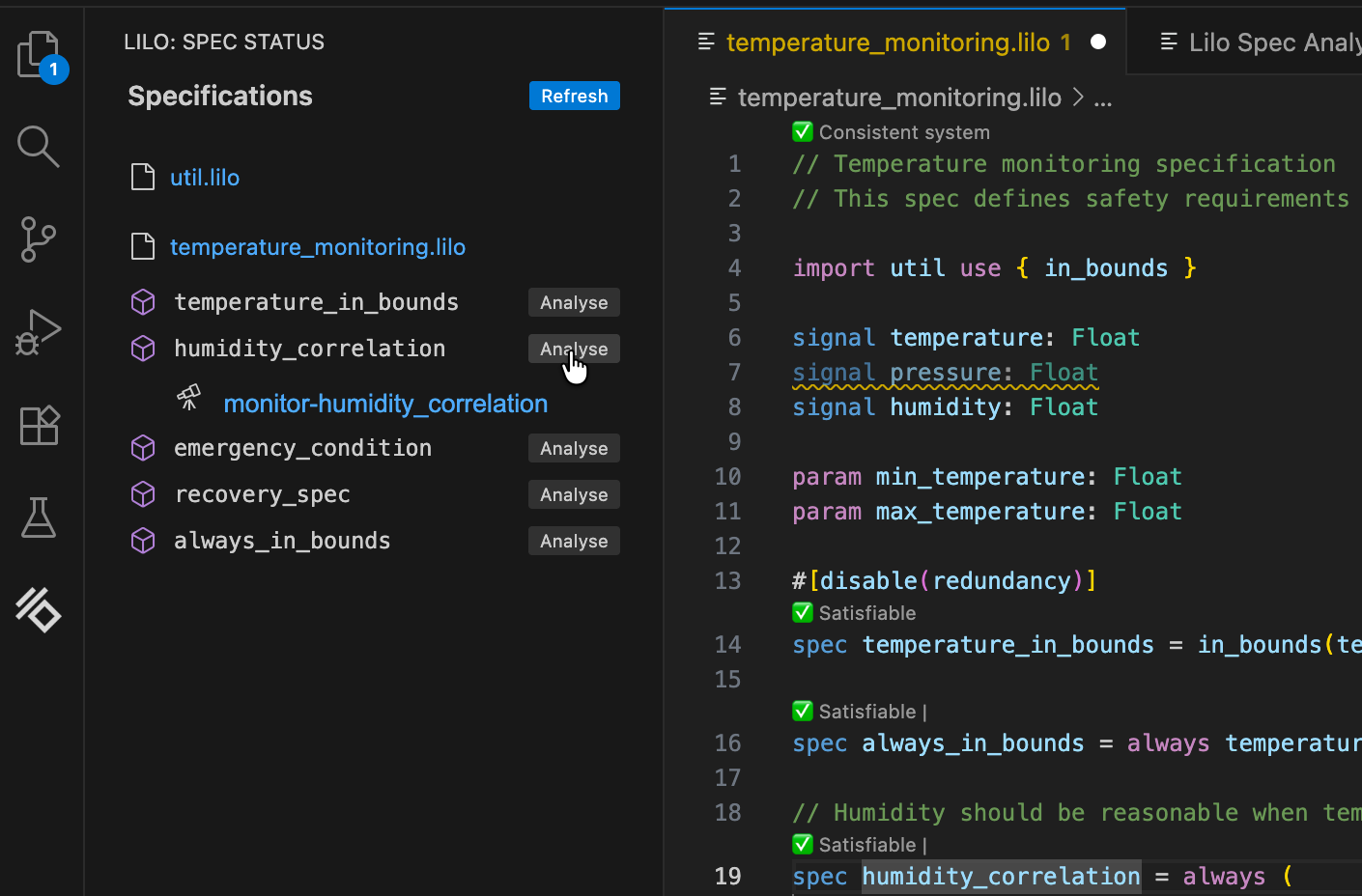
After selecting a data file from the dropdown menu, click Run Analysis. The result is an analysis monitoring tree for the specification:
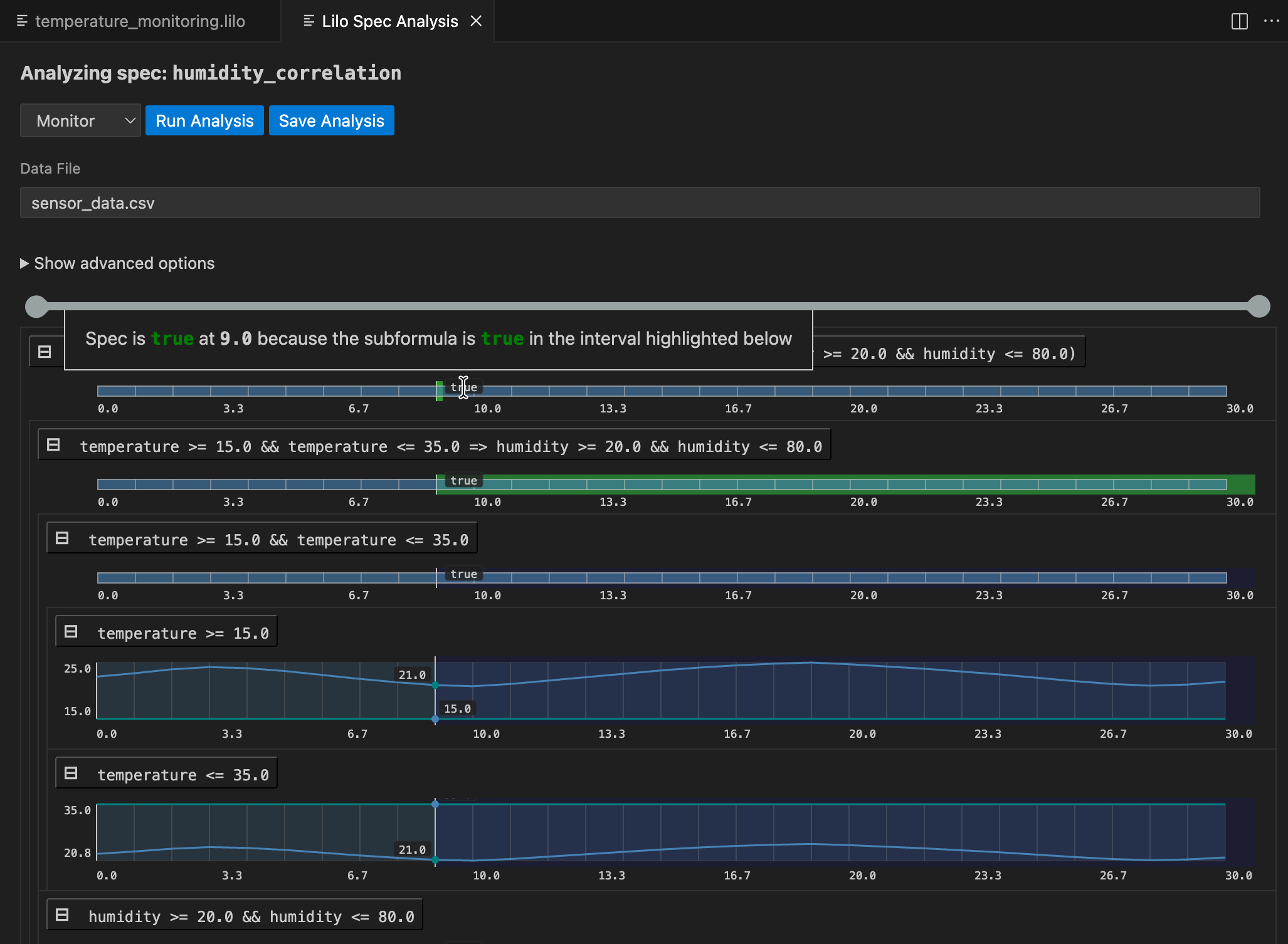
The result for the whole specification is shown at the top. Below this, you can drill down into sub-expressions of the specification, to understand what makes the spec true or false at any given time. Hovering over any of the signals will show a popup with an explanation of the result at that point in time, and will highlight relevant segments of sub-expression result signals.
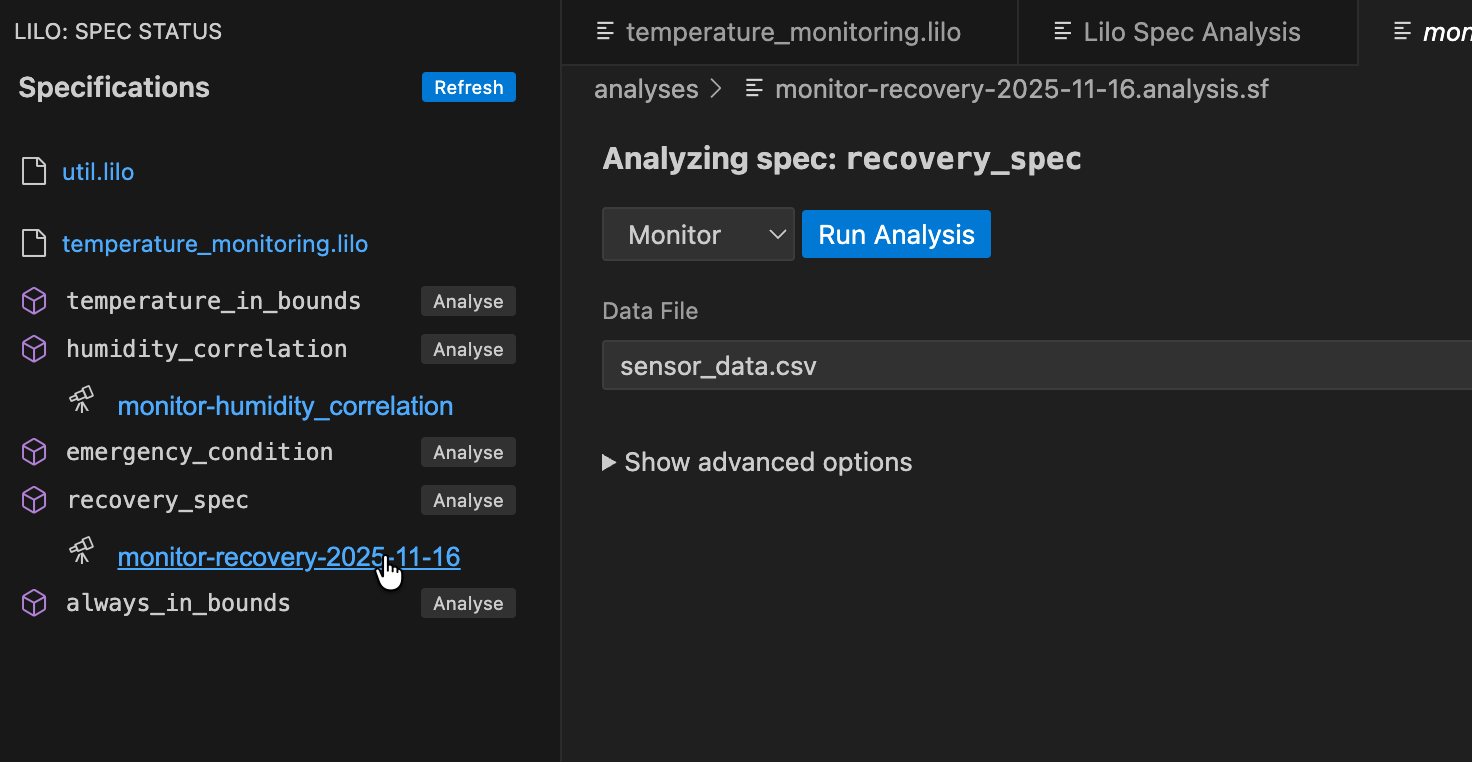
An analysis can be saved. To do so, click the Save Analysis button, and choose a location to save the analysis. You can then navigate to this analysis file and open it again in VSCode. The analysis will also show up in the specification status menu, under the relevant spec.
Exemplification
The Exemplify analysis generates example traces that demonstrate satisfying behavior. This is useful for:
- Understanding what valid system behavior looks like
- Testing other components with realistic data
- Creating animations
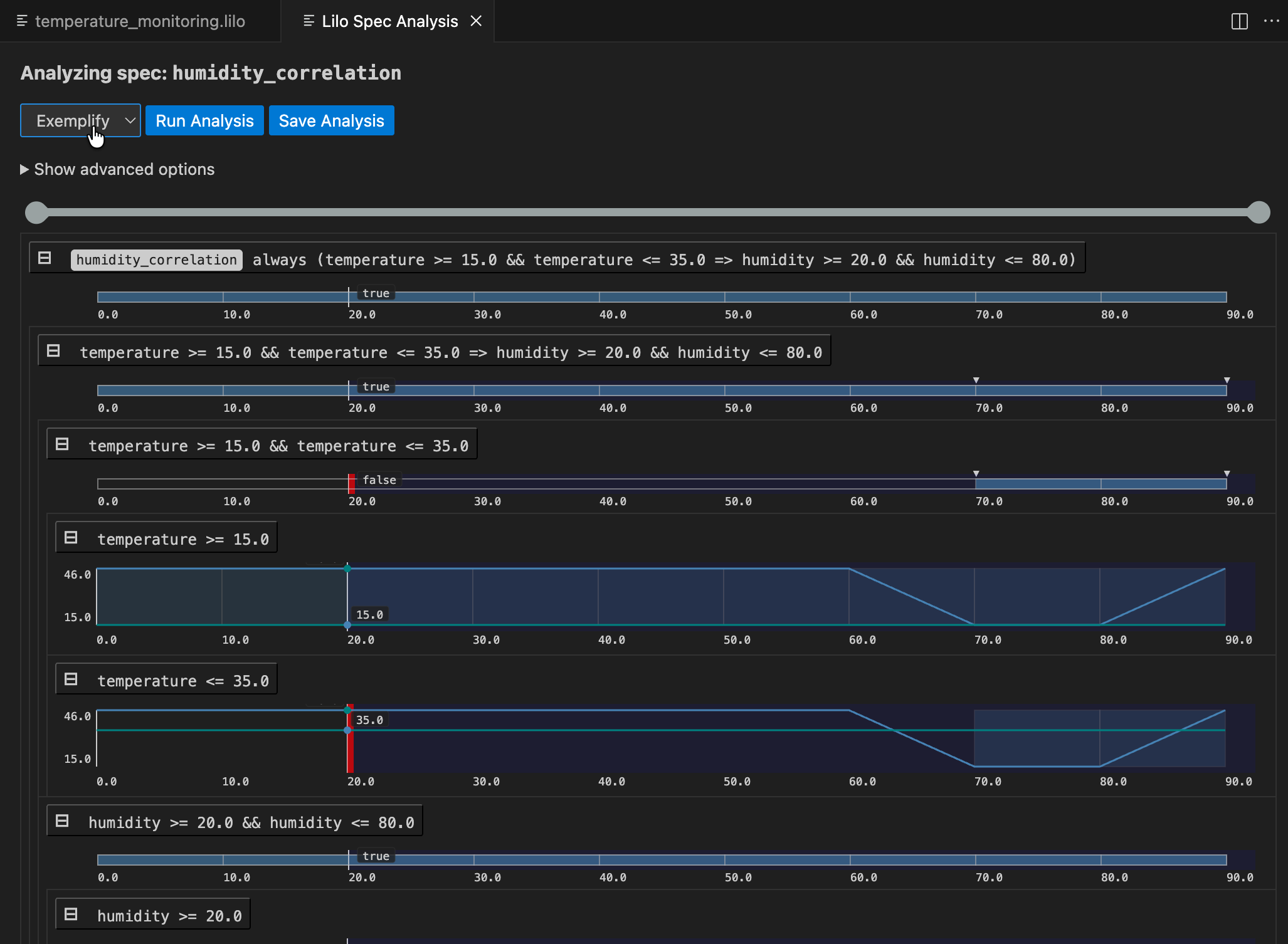
If the exemplified data does not behave as expected, the specification might be wrong and need to be corrected. Exemplification can thus be used as an aid when authoring specifications.
Falsification
If a model for the system is available, falsification can be used to see if the model behaves as expected, that is, according to specification.
First a falsifier must be registered in lilo.toml, e.g.
name = "automatic-transmission"
source = "spec"

[[system_falsifier]]
name = "AT Falsifier"
system = "transmission"
script = "transmission.py"
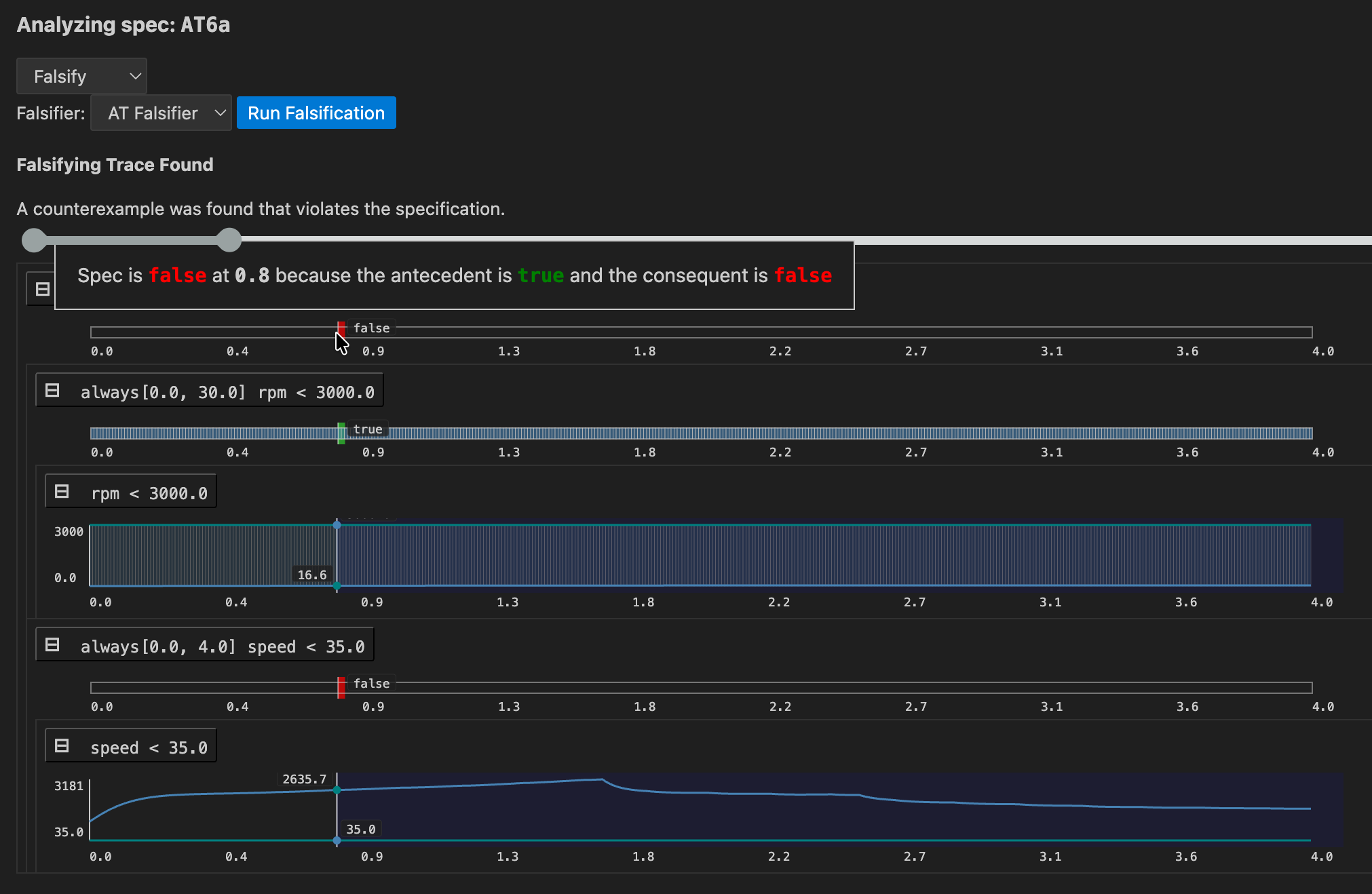
Once this is done, the falsifier will show up in the Falsify analysis menu. If a falsifying signal is found, the monitoring tree is show, to help understand how the model went wrong:
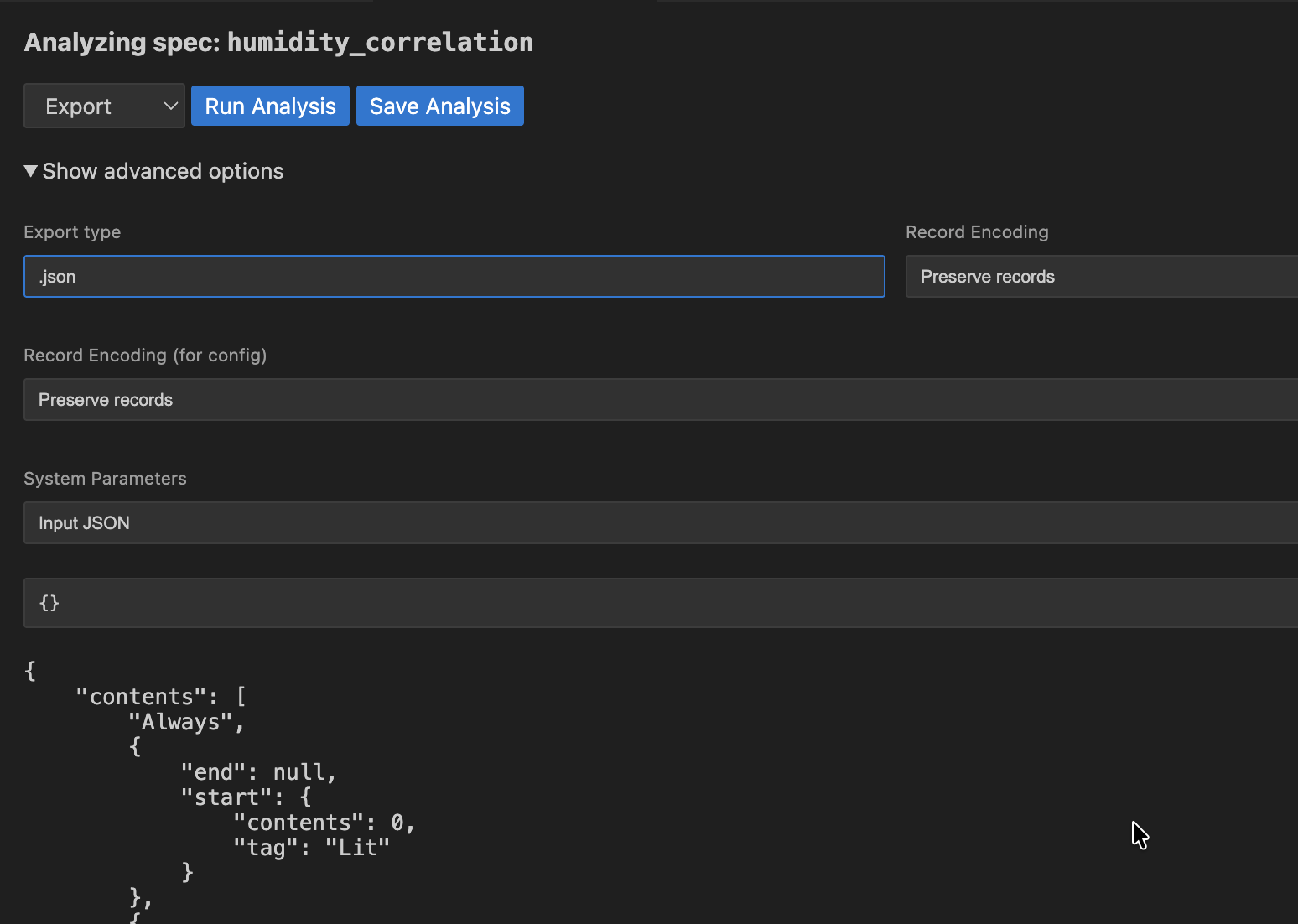
Export
Export converts your specifications to other formats, to be used in other tools. For example, if you want to export your specification to JSON format, choose .json as the Export type.
Next Steps
This tour covered the basics of what SpecForge can do. The following chapters dive deeper into:
- The full Lilo language (Lilo Language)
- System definitions and composition (Systems)
- The Python SDK for programmatic access (Python SDK)
Lilo Language
Lilo is a formal specification language designed for describing, verifying and monitoring the behavior of complex, time-dependent systems.
Lilo allows you to:
- Write expressions using a familiar syntax with powerful temporal operators for defining properties over time.
- Define data structures using records to model your system’s data.
- Structure your specifications using systems.
Language Basics
Types and Expressions
Lilo is an expression-based language. This means that most constructs, from simple arithmetic to complex temporal properties, are expressions that evaluate to a time-series value. This section details the fundamental building blocks of Lilo expressions.
Comments
Comment blocks start with /* and end with */. Everything between these markers is ignored.
A line comment start with //, and indicates that the rest of the line is a comment.
Docstrings start with /// instead of //, and attach documentation to various language elements.
Primitive types
Lilo is a typed language. The primitive types are:
Bool: Boolean values. These are writtentrueandfalse.Int: Integer values, e.g.42.FloatFloating point values, e.g.42.3.String: Text strings, written between double-quotes, e.g."hello world".
Type errors are signaled to the user like this:
def x: Float = 1.02

def n: Int = 42

def example = x + n
The code blocks in this documentation page can be edited, for example try changing the type of n to Float to fix the type error.
Units of Measure
Lilo supports units of measure for Float values. Units are written in angle brackets <...> immediately after a literal.
Basic Units
A simple unit is written as an identifier inside angle brackets:
1.0<cm>
100.0<km/h>
A unit changes the type of the literal from Float to a dimensioned type. In the previous example, the type is changed from Float to Float<cm> or Float<km/h>.
Compound Units
Units can be combined using operators. The literal 1 represents a dimensionless unit:
60.0<1/s>
-
Ratio (
/):15.0<m/s> -
Product (
*):50.0<m*m> -
Exponentiation (
^):100.0<m^2>9.81<m*s^-2>
Operator Precedence and Associativity
Unit operators follow standard mathematical precedence rules:
- Exponentiation (
^) has the highest precedence and binds tightly to the immediately preceding unit. - Product (
*) and ratio (/) have equal precedence and associate left-to-right.
This means m/s*kg is interpreted as (m/s)*kg, and m*s^-2 means m*(s^-2), not (m*s)^-2.
Parentheses for Grouping
Parentheses can be used to override the default precedence and associativity:
1.0<1/(kg*m)>
Operations on Lieterals with Units
You can perform addition, subtraction and comparison on literals with units, such as:
100.0<km> + 10.0<km>
50.2<km> - 3.0<km>
6.5<km> > 3.6<km>
When performing these operations, the units of the first and second arguments must be the same. Otherwise, a type error will occur.
You can perform multiplication or division even if the units of the first and second arguments are different, such as:
100.0<km> * 2.0<s>
100.0<km> / 2.0<s>
These are evaluated as 200.0<km*s> and 50.0<km/s>, respectively.
Inference
Units can be inferred. In the following example, the type of speed is inferred to be Float<m/s>.
def f(speed) = speed * 5.0<s> <= 10.0<m>
Identification
Units are identified as strings. Thus, for example, m and km have no relation as units. To relate them, for example, define a function to convert from km to m.
def km_to_m(kilometre: Float<km>) = kilometre * 1000.0<m/km>
Declaring Units
Units used in type annotations must be declared with the unit keyword:
unit km
unit h
unit s
Once declared, units can be used in signal and definition type annotations:
signal speed: Float<km/h>
signal distance: Float<km>
Operators
Lilo uses the following operators, listed in order of precedence (from highest to lowest).
-
Prefix negation:
-xis the additive inverse ofx, and!xis the negation ofx. -
Multiplication and division:
x * y,x / y. -
Addition and subtraction:
x + yandx - y. -
Numeric comparisons:
==: equality!=: non-equality>=: greater than or equals<=: less than or equals>: greater than (strict)<: less than (strict) Comparisons can be chained, in a consistent direction. E.g.0 < x <= 10means the same thing as0 < x && x <= 10.
-
Temporal operators (See Semantics of Temporal Operators for details):
always φ:φis true at all times in the future.eventually φ:φis true at some point in the future.past φ:φwas true at some time in the past.historically φ:φwas true at all times in the past.will_change φ:φchanges value at some point in the future.did_change φ:φchanged value at some point in the past.φ since ψ:φis true at all points in the past, from some point whereψwas true.φ until ψ:φis true at all points in the future untilψbecomes true.φ releases ψ: shortcut for!(!φ until !ψ).next f: The value off(not necessarily boolean) at the next (discrete) time point, or retains its value if there is no next time point.previous f: The value off(not necessarily boolean) at the previous (discrete) time point, or retains its value if there is no previous time point.previous_with v f: The value off(not necessarily boolean) at the previous (discrete) time point, orvif there is no previous time point.next_with v f: The value off(not necessarily boolean) at the next (discrete) time point, orvif there is no next time point.
One can chain unary temporal operators without parentheses, e.g,
always eventually (x < 0).Temporal operators can be qualified with intervals:
always [a, b] φ:φis true at all times betweenaandbtime units in the future.eventually [a, b] φ:φis true at some point betweenaandbtime units in the future.φ until [a, b] ψ:φis true at all points between now and some point betweenaandbtime units in the future untilψbecomes true.φ releases [a, b] ψ: shortcut for!(!φ until [a, b] !ψ).- Similar interval qualifications apply to other temporal operators.
- One can use
infinityin intervals:[0, infinity].
-
Sliding Window Operators
max_future [0, a] φ: the maximum value ofφin the nextatime units.min_future [0, a] φ: the minimum value ofφin the nextatime units.max_past [0, a] φ: the maximum value ofφin the pastatime units.min_past [0, a] φ: the minimum value ofφin the pastatime units.- Note that the interval must be of the form
[0, a]. - Similar to other temporal operators, one can omit the interval to mean
[0, infinity].
-
Conjunction:
x && y, bothxandyare true. -
Disjunction:
x || y, one ofxoryis true. -
Implication and equivalence:
x => y: ifxis true, thenymust also be true.x <=> y:xis true if and onlyyis true.
Note that prefix operators cannot be chained. So one must write -(-x), or !(next φ).
Built-in functions
There are built-in functions:
-
floatwill produce aFloatfrom anInt:def n: Int = 42 def x: Float = float(n) -
timewill return the current time of the signal. -
sqrtreturns the square root of a numeric value. The argument must be anIntor dimensionlessFloat:sqrt(x) -
absreturns the absolute value of a numeric value. The argument must be anIntorFloat, and units are preserved:abs(x) -
maxreturns the maximum of two or more numeric values. All arguments must have the same type and units:max(x, y) -
minreturns the minimum of two or more numeric values. All arguments must have the same type and units:min(x, y)
Conditional Expressions
Conditional expressions allow a specification to evaluate to different values based on a boolean condition. They use the if-then-else syntax.
if x > 0 then "positive" else "non-positive"
A key feature of Lilo is that if/then/else is an expression, not a statement. This means it always evaluates to a value, and thus the else branch is mandatory.
The expression in the if clause must evaluate to a Bool. The then and else branches must produce values of a compatible type. For example, if the then branch evaluates to an Int, the else branch must also evaluate to an Int.
Conditionals can be used anywhere an expression is expected, and can be nested to handle more complex logic.
// Avoid division by zero
def safe_ratio(numerator: Float, denominator: Float): Float =
  if denominator != 0.0 then
    numerator / denominator
  else
    0.0 // Return a default value

// Nested conditional
def describe_temp(temp: Float): String =
  if temp > 30.0
    then "hot"
  else if temp < 10.0
    then "cold"
  else
    "moderate"
Note that if _ then _ else _ is pointwise, meaning that the condition applies to all points in time, independently.
Case Expressions
If all the branches of a conditional expressions are Bool, you can use a cases expression.
cases {
  temp > 30.0 -> eventually temp < 20.0;
  temp < 10.0 -> eventually temp > 20.0;
  10.0 <= temp <= 30.0 -> true;
}
This is interpreted as (temp > 30.0) => (eventually temp < 20.0) && (temp < 10.0 => eventually temp > 20.0) && (10.0 <= temp <= 30.0 => true). Thus, the case 10.0 <= temp <= 30.0 -> true can be omitted. However, we recommend using exhaustive and disjoint conditions for clarity.
Records
Records are composite data types that group together named values, called fields. They are essential for modeling structured data within your specifications.
The Lilo language supports anonymous, structurally typed, extensible records.
Construction and Type
You can construct a record value by providing a comma-separated list of field = value pairs enclosed in curly braces. The type of the record is inferred from the field names and the types of their corresponding values.
For example, the following expression creates a record with two fields: foo of type Int and bar of type String.
{ foo = 42, bar = "hello" }
The resulting value has the structural type { foo: Int, bar: String }. The order of fields in a constructor does not matter.
You can also declare a named record type using a type declaration, which is highly recommended for clarity and reuse.
/// Represents a point in a 2D coordinate system.
type Point = { x: Float, y: Float }

// Construct a value of type Point
def origin: Point = { x = 0.0, y = 0.0 }
Field punning
When you already have a name in scope that should be copied into a record, you can pun the field by omitting the explicit assignment. A pun such as { foo } is shorthand for { foo = foo }.
def foo: Int = 42
def bar: String = "hello"

def record_with_puns = { foo, bar }
Punning works anywhere record fields are listed, including in record literals and updates. Each pun expands to a regular field = value pair during typechecking.
Path field construction
Nested records can be created or extended in one step by assigning to a dotted path. Each segment before the final field refers to an enclosing record, and the compiler will merge the pieces together.
type Engine = { status: { throttle: Int, fault: Bool } }

def default_engine: Engine =
  { status.throttle = 0, status.fault = false }
The order of path assignments does not matter; the paths are merged into the final record. A dotted path cannot be combined with punning; write { status.throttle = throttle } instead of { status.throttle } when you need the path form.
Record updates with with
Use { base with fields } to copy an existing record and override specific fields. Updates respect the same syntax rules as record construction: you can mix regular assignments, puns, and dotted paths.
type Engine = { status: { throttle: Int, fault: Bool } }

def base: Engine =
  { status.throttle = 0, status.fault = false }

def warmed_up: Engine =
  { base with status.throttle = 70 }

def acknowledged: Engine =
  { warmed_up with status.fault = false }
All updated fields must already exist in the base record. Path updates let you rewrite deeply nested pieces without rebuilding the entire structure.
Projection
To access the value of a field within a record, you use the dot (.) syntax. If p is a record that has a field named x, then p.x is the expression that accesses this value.
type Point = { x: Float, y: Float }

def is_on_x_axis(p: Point): Bool =
  p.y == 0.0
Records can be nested, and projection can be chained.
type Point = { x: Float, y: Float }
type Circle = { center: Point, radius: Float }

def is_unit_circle_at_origin(c: Circle): Bool =
  c.center.x == 0.0 && c.center.y == 0.0 && c.radius == 1.0
Local Bindings
Local bindings allow you to assign a name to an expression, which can then be used in a subsequent expression. This is accomplished using the let keyword and is invaluable for improving the clarity, structure, and efficiency of your specifications.
A local binding takes the form let name = expression1; expression2. This binds the result of expression1 to name. The binding name is only visible within expression2, which is the scope of the binding.
The primary purposes of let bindings are:
- Readability: Breaking down a complex expression into smaller, named parts makes the logic easier to follow.
- Re-use: If a sub-expression is used multiple times, binding it to a name avoids repetition and potential re-computation.
Consider the following formula for calculating the area of a triangle’s circumcircle from its side lengths a, b, and c:
def circumcircle(a: Float, b: Float, c: Float): Float =
  (a * b * c) / sqrt((a + b +c) * (b + c - a) * (c + a - b) * (a + b - c))
Using let bindings makes the logic much clearer:
def circumcircle(a: Float, b: Float, c: Float): Float =
  let pi = 3.14;
  let s = (a + b + c) / 2.0;
  let area = sqrt(s * (s - a) * (s - b) * (s - c));
  let circumradius = (a * b * c) / (4.0 * area);
  circumradius * circumradius * pi
The type of the bound variable (s, area, circumradius) is automatically inferred from the expression it is assigned. You can also chain multiple let bindings to build up a computation step-by-step.
Systems
Systems
Ultimately Lilo is used to specify systems. A system groups together declarations for the temporal input signals, the (non-temporal) parameters and the specifications. A system also includes auxiliary definitions.
A system file should start with a system declaration, e.g.:
system Engine
The name of the system should match the file name.
Type declarations
A new type is declared with the type keyword. To define a new record type Point:
type Point = { x: Float, y: Float }
We can then use Point as a type anywhere else in the file.
Signals
The time varying values of the system are called signals. They are declared with the signal keyword. E.g.:
signal x: Float
signal y: Float
signal speed: Float
signal rain_sensor: Bool
signal wipers_on: Bool
The definitions and specifications of a system can freely refer to the system’s signals.
A signal can be of any type that does not contain function types, i.e. a combination of primitive types and records.
System Parameters
Variables of a system which are constant over time are called system parameters. They are declared with the param keyword. E.g.:
param temp_threshold: Float
param max_errors: Int
The definitions and specifications of a system can freely refer to the system’s parameters. Note that system parameters must be provided upfront before monitoring can begin. For exemplification, system parameters are optional. That is, they can be provided, in which case the example must conform to them, or otherwise the exemplification process will try to find values that work.
Definitions
A definition is declared with the def keyword:
def foo: Int = 42
A definition can depend on parameters:
def foo(x: Float) = x + 42
One can also specify the return type of a definition:
def foo(x: Float): Float = x + 42
The type annotations on parameters and the return type are both optional, if they are not provided they are inferred. It is recommended to always specify these types as a form of documentation.
The parameters of a definition can also be be record types, for instance:
type S = { x: Float, y: Float }

def foo(s: S) = eventually [0,1] s.x > s.y
Definitions can be used in other definitions, e.g.:
type S = { x: Float, y: Float }

def more_x_than_y(s: S) = s.x > s.y

def foo(s: S) = eventually [0,1] more_x_than_y(s)
Definitions can be specified in any order, as long as this doesn’t create any circular dependencies.
Definitions can freely use any of the signals of the system, without having to declare them as parameters.
Specifications
A spec says something that should be true of the system. They can use all the signals and defs of the system. They are declared using the spec keyword. They are much like defs except:
- The return type is always
Bool(and doesn’t need to be specified) - They cannot have parameters.
Example:
signal speed: Float

def above_min = 0 <= speed

def below_max = speed <= 100

spec valid_speed =
  always (above_min && below_max)
Assumptions
An assumption declares a property that is taken as given when analysing the system. Syntactically it is like a spec — no parameters, return type is always Bool — but it is treated differently by the tooling: assumptions are automatically included as constraints during exemplification and satisfiability checking, rather than being something to verify.
signal temperature: Float
signal heater_on: Bool

assumption physics = always (heater_on => next temperature >= temperature)

spec eventually_warm = eventually (temperature > 30.0)
In this example, physics must hold for any example traces SpecForge generates, or when checking satisfiability for specs. See Exemplification and Satisfiability for more details on how assumptions interact with analysis.
Modules
Modules
Lilo language supports modules. A module starts with a module declaration, and contains definitions (much like a system):
module Util

def add(x: Float, y: Float) = x + y

pub def calc(x: Float) = add(x, x)
The name of the module must match the file name. For example, a module declared as module Util must be defined in a file named Util.lilo.
A module can only contain defs and types.
Those definitions which should be accessible from other modules should be parked as pub, which means “public”.
To use a module, one needs to import it, e.g. import Util. The public definitions from Util are then available to be used, with qualified names, e.g.:
import Util

def foo(x: Float) = Util::calc(x) + 42
One can import a module qualified with an alias, for example:
import Util as U

def foo(x: Float) = U::calc(x) + 42
To use symbols without a qualifier, use the use keyword:
import Util use { calc }

def foo(x: Float) = calc(x) + 42
To import units from another module, prefix each unit with the unit keyword in the use list:
import Units use { unit m, unit s }
Components
Components are a way of organizing Lilo Systems in hierarchical building blocks.
Consider the following Vehicle system, which is organized in the following way:
- A
Vehiclehas aPowerUnitand aBattery. - The battery consists of two
BatteryCells. - Each of the systems
PowerUnit,Battery,BatteryCellandVehiclehave their own signals, parameters and specifications.
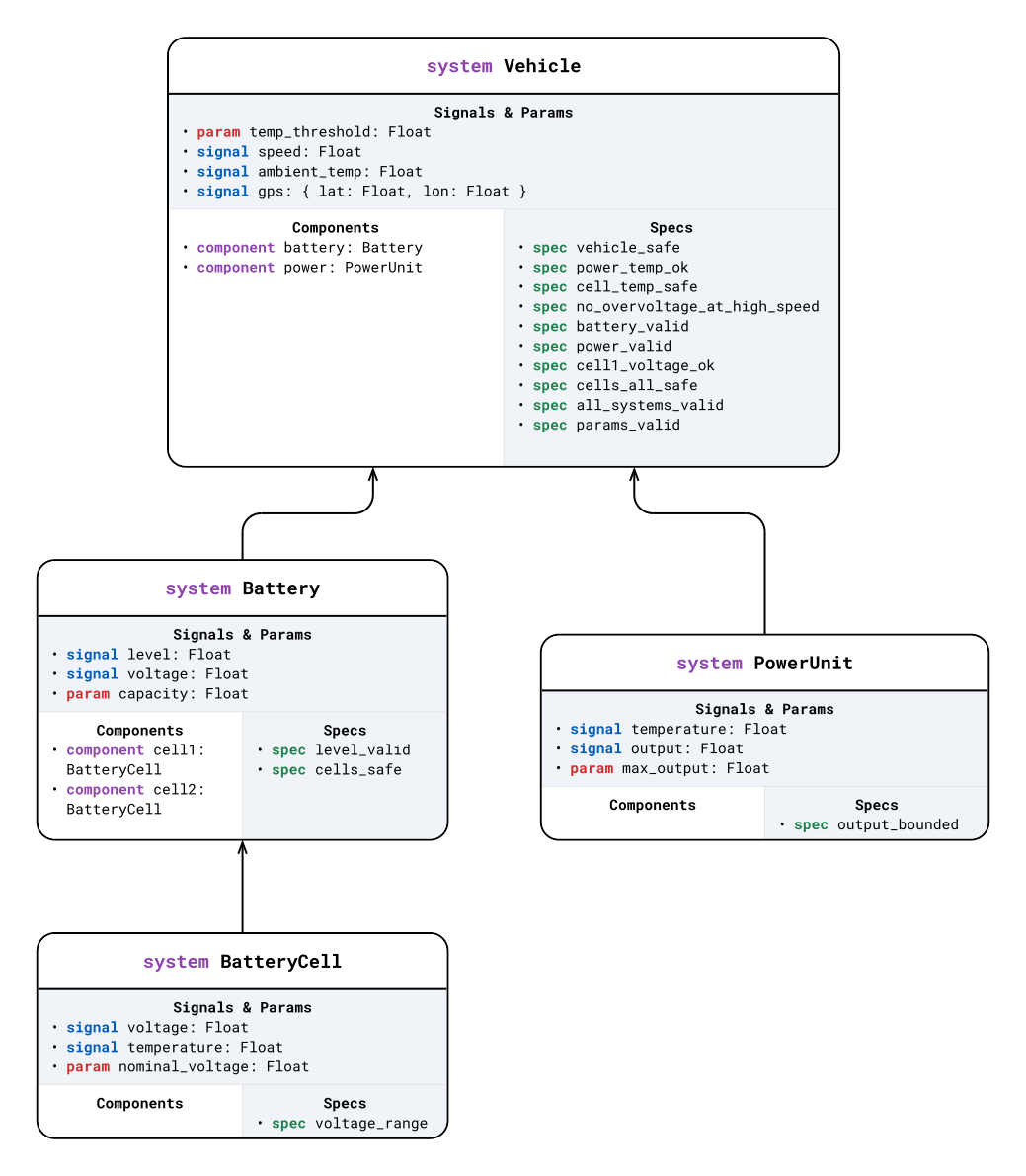
The systems BatteryCell and PowerUnit do not have any components, so they can be declared in a straightforward way:
// BatteryCell.lilo
system BatteryCell

pub signal voltage: Float
pub signal temperature: Float
pub param nominal_voltage: Float

pub def over_voltage: Bool = voltage > nominal_voltage * 1.15

spec voltage_range = voltage >= 2.5 && voltage <= 4.5

// PowerUnit.lilo
system PowerUnit

pub signal temperature: Float
pub signal output: Float
pub param max_output: Float

pub def is_overheating: Bool = temperature > 85.0

spec output_bounded = output <= max_output
Here, the use of the pub keyword indicates that these signals, params and definitions will be accessible to other systems which instantiate these systems as components. Specifications declared with spec are always public.
Instantiating Components
The Battery system uses BatteryCell components, which can be declared using the component keyword:
// Battery.lilo

system Battery

pub signal level: Float
pub signal voltage: Float
pub param capacity: Float

component cell1: BatteryCell

// ...
Lifted vs Mapped Signals and Params
When a system is instantiated as a component in another system, its params and signals are lifted to the parent system. Thus, in addition to level, voltage and capacity, the schema for Battery involves cell1::voltage, cell1::temperature and cell1::nominal_voltage.
Some signals or params of a component may be mapped, meaning that they are not a part of the input schema, but their values are determined by other signals or params (of the parent system). For example, consider the following example where the schema of Battery still exposes cell1::voltage, cell1::temperature and cell1::nominal_voltage, as well as cell2::temperature, but not cell2::nominal_voltage or cell2::voltage. The value of cell2::nominal_voltage is fixed to 3.7, and the value of cell2::voltage is derived from the Battery’s voltage signal.
// Unmapped component - all signals and params will be lifted
component cell1: BatteryCell

// Partially mapped component - voltage is mapped, temperature is lifted
component cell2: BatteryCell {
  param nominal_voltage = 3.7
  signal voltage = voltage / 2.0  // Derived from battery voltage
}
Accessing Component Signals and Params
Lilo expressions in a system can refer to signals and params of their components using the :: operator to access the component’s signals and params.
// Use cell component signals
pub def any_cell_over_voltage: Bool = cell1::over_voltage || cell2::over_voltage

spec level_valid = level >= 0.0 && level <= 100.0

// Reference cell component specs
spec cells_safe = cell1::voltage_range && cell2::voltage_range
A system can refer to signals and params of components of its components. For example, consider the Vehicle system which has both a Battery and a PowerUnit component. One can write specifications in the Vehicle system in the following manner.
// Vehicle.lilo

// ...

// Two-level signal references

def low_battery: Bool = battery::level < 20.0
def power_hot: Bool = power::temperature > 80.0

def bat_cell1_voltage: Float = battery::cell1::voltage

def at_meihan: Bool = 34.63 < gps.lat < 34.65 && 135.99 < gps.lon < 136.01

// Three-level signal references (Vehicle -> Battery -> BatteryCell)

def cell1_overheated: Bool = battery::cell1::temperature > 65.0
def cell2_voltage_ok: Bool = battery::cell2::voltage > 3.0

// Two-level def references

def battery_or_power_issue: Bool = battery::is_low || power::is_overheating

// Three-level def references (Vehicle -> Battery -> BatteryCell)

def any_cell_overvoltage: Bool = battery::cell1::over_voltage || battery::cell2::over_voltage

// Combined two-level and three-level
def critical_state: Bool = battery::is_low && battery::any_cell_over_voltage

// ...
System Schema
The schema of a system refers to the set of signals and params that constitutes it input. When monitoring, the user provides values for elements of the schema. The schema corresponding to the Vehicle system is shown in the diagram below.
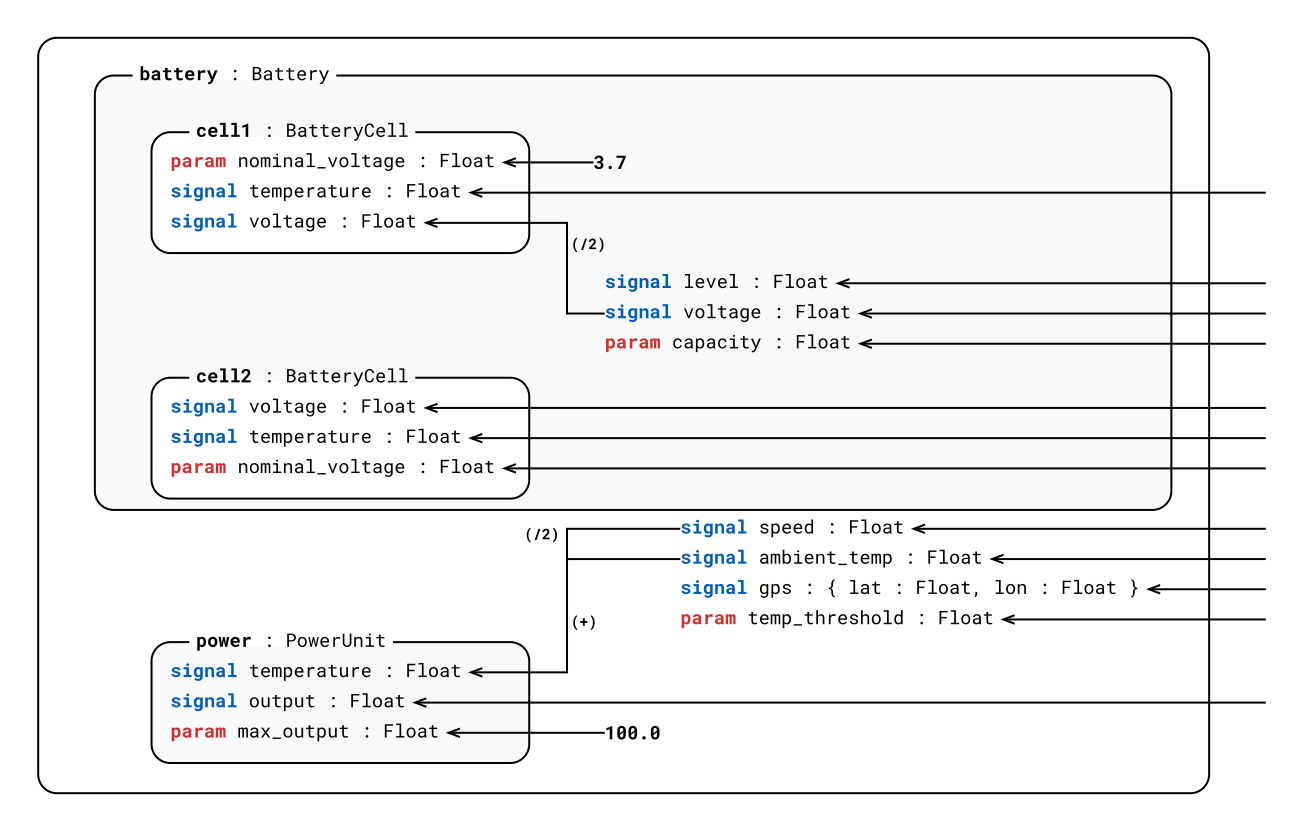
The SpecForge CLI schema command can be used to view the schema of a system. Notice that the mapped signals and params do not appear in the schema, since their values are derived from different signals or params.
$ schema --project /Users/agnishom/code/reqeng/api/examples/projects/vehicle -s Vehicle flat
Signals:
  ambient_temp  Float
  battery::cell1::temperature  Float
  battery::cell1::voltage  Float
  battery::cell2::temperature  Float
  battery::level  Float
  battery::voltage  Float
  gps_lat  Float
  gps_lon  Float
  power::output  Float
  speed  Float


Params:
  battery::capacity  Float
  battery::cell1::nominal_voltage  Float
  temp_threshold  Float   (default: 75.0)
Refer to the documentation on Data Files for details on the format for providing values for the schema when monitoring.
Static Analysis
Static Analysis
System code goes though some code quality checks.
Consistency Checking
Specs are checked for consistency. A warning is produced if specs may be unsatisfiable:
signal x: Float

spec main = always (x > 0 && x < 0)
This means that the specification is problematic, because it is impossible that any system satisfies this specification.
Inconsistencies between specs are also reported to the user:
signal x: Float

spec always_positive = always (x > 0)
spec always_negative = always (x < 0)
In this case each of the specs are satisfiable on their own, but taken together they cannot be satisfied by any system.
Redundancy Checking
If one spec is redundant, because implied by other specs of the system, this is also detected:
signal x: Float

spec positive_becomes_negative = always (x > 0 => eventually x < 0)

spec sometimes_positive = eventually x > 0

spec sometimes_negative = eventually x < 0
In this case we warn the user that the spec sometimes_negative is redundant, because this property is already implied by the combination of positive_becomes_negative and sometimes_positive. Indeed sometimes_positive implies that there is some point in time where x > 0, and using positive_becomes_negative we conclude that therefore there must be some point in time after than when x < 0.
Guard Analysis for Case Expressions
If a spec is a case expression, we check the guards in the case expression for satisfiability, exhaustiveness, and disjointness.
spec example = cases {
    guard1 -> consequence1;
    guard2 -> consequence2;
    ...
}
- Satisfiability: Whether each guard is satisfiable on its own.
- Exhaustiveness: Whether the guards taken together cover all possible cases.
- Disjointness: Whether the guards are mutually exclusive.
Additional Features
Attributes
In addition to docstrings (which begin with ///), Lilo definitions, specs, params and signals can be annotated with attributes. They must immediately precede the item they annotate.
The attributes are used to convey metadata about items they annotate which is used by the tooling (notably the VSCode extension).
#[key = "value", fn(arg), flag]
spec foo = true
- Suppressing unused variable warnings:
#[disable(unused)]- Using this attribute on a definition, param or signal will suppress warnings about it being unused.
- Specs or public definitions are always considered used.
- Timeout for Static Analyses
- To override the default timeout for static analyses, a
timeoutcan be specified in seconds. - They can be specified individually
#[timeout(satisfiability = 20, redundancy = 30)] - Or together
#[timeout(10)]which sets both to 10 seconds.
- To override the default timeout for static analyses, a
- Disabling static analyses
- Use
#[disable(satisfiability)]or#[disable(redundancy)]to disable specific static analyses on a definition.
- Use
- Soft assumptions:
#[rigidity = "soft"]- Applied to an
assumption, marks it as a soft constraint that the solver tries to satisfy but may relax if it conflicts with hard constraints. See Rigidity Levels for details.
- Applied to an
Labels, Aliases, and Custom Fields
Specifications can be annotated with labels, aliases, and custom fields, using attributes.
A label is a string attached to a specification. The VSCode extension’s spec sidebar groups specifications by label. This is useful for focusing on a subset of specifications, such as the safety-related ones.
#[label("safety", "critical")]
spec brake_must_work = always (brake_pedal => eventually (deceleration > 0))
An alias is an alternative name in a particular language. The spec sidebar shows the alias alongside the name used in the source file.
#[alias(en = "Brake Must Work", ja = "ブレーキは動作しなければならない")]
spec brake_must_work = always (brake_pedal => eventually (deceleration > 0))
A specification can have multiple #[label] or #[alias] attributes. All of them are applied.
A label can be associated with a color (represented via a hex code or any standard HTML5 color name) in the lilo.toml config file. To do so, simply add a section [labels.colors] like the following:
[labels.colors]
production = "blue"
consumption = "magenta"
renewable = "0x00ff00"
'mitigation strategy' = "yellow"
Custom fields attach extra scalar metadata to a specification. They are useful for project-specific categorization such as review status, owner, priority, etc.
#[field(priority = 1, reviewed = true, owner = "ops")]
spec brake_must_work = always (brake_pedal => eventually (deceleration > 0))
Custom field values must be scalar values (strings, numbers, booleans). For a single specification, if the same custom field is provided more than once, the first value is used and a warning is emitted.
The VSCode extension can use custom fields in the Spec Status Pane filter. For example:
reviewed:trueowner:"ops"priority:>=2
See VSCode Extension for the full query syntax.
Default Values for Parameters
When specifying a system, parameters can optionally be given a default value. The intent of such a default value is to indicate that the parameter is expected to be instantiated with the default value in a typical use case.
#[default = 25.0]
param temperature: Float
Default values should not be used to declare constants. For them, use a def instead.
def pi: Float = 3.14159
- When monitoring, parameters with default values can be omitted from the input. If omitted, the default value is used. They can also be explicitly provided, in which case the provided value is used.
- When exporting a formula, parameters with a default value will be substituted with the default value before the export.
- When exemplifying, the exemplifier will require the solver to fix the parameter to the default value.
When running an analysis such as export or exemplification, one can provide the JSON null value for a field in the config. This has the effect of requesting SpecForge to ignore the default value for the parameter.
system main

signal p: Int
#[default = 1]
param bound: Int

spec foo = p > 1 && p < bound
- Exemplification
- With
params = {}: Unsatisfiable (the default value ofboundis used) - With
params = { "bound": null }: Satisfiable (the solver is free to choose a value ofboundthat satisfies the constraints)
- With
- Export
- With
params = {}, result:p > 1 && p < 1 - With
params = { "bound": 100 }, result:p > 1 && p < 100 - With
params = { "bound": null }, result:p > 1 && p < bound
- With
Note that the JSON null value cannot be used as a default value as a part of the Lilo program.
Spec Stubs
The user may create a spec stub, a spec without a body. Such a stub may still have a docstring and attributes. This can be used as a placeholder, and is interpreted as true by the Lilo tooling.
The VSCode extension will display a codelens to generate an implementation for the stub based on the docstring using an LLM (if configured).
/// The system should always eventually recover from errors.
spec error_recovery
Stubs can also be used for assumptions which have not yet been formalized.
/// height is always non-negative
assumption height_non_negative
Conventions
Some languages require that certain classes of names be capitalized or not, to distinguish them. Lilo is flexible, so that it can match the naming conventions of the system it is being used to specify. That said, here are the conventions that we use in the examples:
- Module and systems are lowercase snake_case. So e.g.
climate_controlrather thanClimateControl. - Important: The name of a module or system must match the file name it is defined in. For example,
module climate_controlorsystem climate_controlmust be defined in a file namedclimate_control.lilo. - Names of
signals,params,defs,specs, arguments and record field names are lowercase and snake_case. So e.g.signal wind_speedrather thansignal WindSpeedorsignal windSpeed. - Types, including user defined ones, should be capitalized and CamelCase. E.g.
type Plane = {
  wind_speed: Float,
  ground_speed: Float
}
Semantics of Temporal Operators
Lilo adopts a semantics for temporal logic that is slightly non-standard, in the sense that it takes into account both a discrete and a continuous notion of time.
Let T be a type. A sample of type T is a pair {time : Real, value : T}. A signal of type T is a finite sequence of at-least two samples of type T such that the time values are strictly increasing. We write Signal[T] to be the set of all signals of type T. We do not require the first sample of a signal to be at time 0. Given a signal σ, we denote the elements of σ as σ[0], σ[1], …, σ[n-1] where n is the number of samples of σ. Note that we distinguish between the number of samples of σ and the duration of σ (which is σ[n-1].time - σ[0].time).
The support of a signal σ, denoted support(σ), is the set of time values associated with the samples of σ, i.e., support(σ) = {σ[i].time | 0 ≤ i < n}. We write σ[time = t] to denote the value of σ at time t, i.e, σ[time = t] = σ[i].value where i is such that σ[i].time = t. Note that σ[time = t] is only defined for t ∈ support(σ).
Each Lilo formula φ is judged to be of some type T (written φ : T), by the Lilo type system. The semantics of a Lilo formula of type T is understood as a function of type Signal[S] → Signal[T], where S is the type of the input signals described by the system. This function is defined to be support-preserving, i.e, the output signal is defined on exactly the same time values as the input signal. For a formula φ of type T, we write 〚φ〛 to denote this function.
Atemporal operators include the standard Boolean operators, arithmetic operators, comparison operators, conditionals and so on. A formula is said to a pointwise formula if for any fixed time value t, the value of the output signal 〚φ〛(σ)[time = t] depends only on the value of the input signal σ[time = t]. A lilo expression is said to be atemporal if its intepretation does not depend on the input signals. Thus, a pointwise formula is built from input signals and atemporal operators, and an atemporal expression is built from params, constants and atemporal operators.
An interval of real numbers is written as a pair [a, b] where a: Real and b: Real | infinity with a ≤ b. If b is infinity, we say that the interval is unbounded, and otherwise we say that the interval is bounded. For a time point t and an interval I, we write t + I or t - I to denote {t + x | x ∈ I} or {t - x | x ∈ I} respectively. In our case, since each of the temporal operators preserves support, we will write t + I and t - I as a shorthand for (t + I) ∩ support(σ) and (t - I) ∩ support(σ).
Temporal operators in Lilo, with some exceptions, are annotated with an interval. Given φ : Bool, we define the following temporal operators.
- Always:
〚always[I] φ〛(σ)[time = t] = trueif and only if for allt' ∈ (t + I),〚φ〛(σ)[time = t'] = true. - Eventually:
〚eventually[I] φ〛(σ)[time = t] = trueif and only if there existst' ∈ (t + I)such that〚φ〛(σ)[time = t'] = true. - Historically:
〚historically[I] φ〛(σ)[time = t] = trueif and only if for allt' ∈ (t - I),〚φ〛(σ)[time = t'] = true. - Past:
〚past[I] φ〛(σ)[time = t] = trueif and only if there existst' ∈ (t - I)such that〚φ〛(σ)[time = t'] = true. - Until:
〚φ until[I] ψ〛(σ)[time = t] = trueif and only if there existst' ∈ (t + I)such that〚ψ〛(σ)[time = t'] = trueand for allt'' ∈ support(σ)satisfyingt ≤ t'' < t',〚φ〛(σ)[time = t''] = true. - Since:
〚φ since[I] ψ〛(σ)[time = t] = trueif and only if there existst' ∈ (t - I)such that〚ψ〛(σ)[time = t'] = trueand for allt'' ∈ support(σ)satisfyingt' < t'' ≤ t,〚φ〛(σ)[time = t''] = true.
Note that the always and eventually operators are logical duals of each other. The logical dual of until is releases, i.e, φ releases[I] ψ is defined as !(!φ until[I] !ψ). The operators since, historically and past are the past-time counterparts of until, always and eventually respectively.
The operators will_change and did_change are defined for any well-typed φ : T for which equality is defined (which is currently all non-function types) as follows.
- Will Change:
〚will_change[I] φ〛(σ)[time = t] = trueif and only if there exists two pointst', t'' ∈ (t + I)such that〚φ〛(σ)[time = t'] ≠ 〚φ〛(σ)[time = t'']. - Did Change:
〚did_change[I] φ〛(σ)[time = t] = trueif and only if there exists two pointst', t'' ∈ (t - I)such that〚φ〛(σ)[time = t'] ≠ 〚φ〛(σ)[time = t''].
The following operators cannot be annotated with an interval. And importantly, they are defined on the discrete time-semantics, i.e, they depend on the discrete index associated with the samples rather than the associated time. If the base formula φ is of type T, and v is an atemporal value of type T, then so are the formulas next φ, previous φ, next_with v φ and previous_with v φ. We write n to denote the number of samples of the input signal σ.
- Next:
〚next φ〛(σ)[i] = 〚φ〛(σ)[i + 1]for0 ≤ i < n - 1and〚next φ〛(σ)[n - 1] = 〚φ〛(σ)[n - 1]. - Previous:
〚previous φ〛(σ)[i] = 〚φ〛(σ)[i - 1]for0 < i < nand〚previous φ〛(σ)[0] = 〚φ〛(σ)[0]. - Next With:
〚next_with v φ〛(σ)[i] = 〚φ〛(σ)[i + 1]for0 ≤ i < n - 1and〚next_with v φ〛(σ)[n - 1] = v. - Previous With:
〚previous_with v φ〛(σ)[i] = 〚φ〛(σ)[i - 1]for0 < i < nand〚previous_with v φ〛(σ)[0] = v.
The following sliding window operators are defined for any φ whose value is a numeric type. Note also that the associated interval must be of the form [0, b] where b is possibly infinity.
- Future Maximum:
〚max_future [0, a] φ〛(σ)[time = t] = max{〚φ〛(σ)[time = t'] | t' ∈ support(σ), t ≤ t' ≤ t + a}. - Past Maximum:
〚max_past [0, a] φ〛(σ)[time = t] = max{〚φ〛(σ)[time = t'] | t' ∈ support(σ), t - a ≤ t' ≤ t}. - Future Minimum:
〚min_future [0, a] φ〛(σ)[time = t] = min{〚φ〛(σ)[time = t'] | t' ∈ support(σ), t ≤ t' ≤ t + a}. - Past Minimum:
〚min_past [0, a] φ〛(σ)[time = t] = min{〚φ〛(σ)[time = t'] | t' ∈ support(σ), t - a ≤ t' ≤ t}.
Exemplification and Satisfiability
Exemplification is the process of generating example traces that satisfy a specification.
Satisfiability is a closely related concept: a spec is satisfiable if there exists at least one trace that makes it true. SpecForge’s static analysis automatically checks whether your specs are satisfiable and warns you if they are not.
Both exemplification and satisfiability checking are influenced by assumptions, which are additional constraints that the solver takes into account.
Assumptions
An assumption is a property that is taken for granted when analysing a specification. Instead of being something you want to verify, it represents background knowledge about the system: physical laws, environmental constraints, or operating conditions that are expected to hold.
The assumption Keyword
In Lilo, you can declare an assumption using the assumption keyword:
signal temperature: Float
signal heater_on: Bool

assumption physics = always (heater_on => next temperature >= temperature)

spec eventually_warm = eventually (temperature > 30.0)
An assumption is syntactically like a spec (it has no parameters and its return type is always Bool) but it is treated differently by the tooling:
- Exemplification: When generating example traces for any spec in the same system, all assumptions are automatically included as constraints. The solver must produce traces that satisfy both the spec and every assumption.
- Satisfiability: When checking whether a spec is satisfiable, assumptions are included in the constraint set. A spec that would be satisfiable on its own may become unsatisfiable under assumptions.
- Redundancy: Assumptions are included alongside other specs when checking for redundancy. A spec that follows from the assumptions (and other specs) will be flagged as redundant.
You can add the #[rigidity = "soft"] attribute to an assumption to make it a soft constraint for the exemplifier. See the section on Rigidity Levels below for details. By default, assumptions are considered hard.
This means you do not need to manually pass assumptions when running analyses. Declaring them in your Lilo source is enough.
Ad-hoc Assumptions
In addition to the assumption keyword, you can pass ad-hoc assumptions when running exemplification through the Python SDK or the VSCode extension. These are one-off constraints that apply only to a specific analysis run, rather than being part of the system definition.
Ad-hoc assumptions are useful when you want to explore “what if” scenarios without modifying your Lilo source, for example “generate a trace where the temperature starts above 20”.
Rigidity Levels
Each assumption (whether declared with the assumption keyword in the source or passed ad-hoc to an exemplification query) has a rigidity level that controls how the solver treats it:
- Hard: The assumption is treated as an inviolable constraint. The generated trace must satisfy the assumption. If the solver cannot find a trace that satisfies both the spec and all hard assumptions, exemplification fails.
- Soft: The assumption is treated as a preference. The solver first attempts to find a trace satisfying the spec and all hard assumptions, then tries to additionally satisfy soft assumptions. If a soft assumption cannot be satisfied together with the hard constraints, it is relaxed and the solver still produces a result.
In practice, use Hard for constraints that are essential (e.g., physical laws, safety bounds) and Soft for constraints that are desirable but not strictly required (e.g., “the temperature should increase at some point”).
Note: Assumptions declared with the
assumptionkeyword default to hard rigidity. To make a keyword-declared assumption soft, annotate it with#[rigidity = "soft"].
Fixing Params to Default Values
When running an exemplification task, Lilo will automatically fix any parameters to their default values, if the Lilo source file supplies them. This means that the exemplifier will be forced to find a model in which the parameters take on those specific values.
In some cases, this can lead to unsatisfiability if the default values are incompatible with the spec or assumptions. In the easy analysis mode on the VSCode extension, you can disable this behavior by unchecking the “Fix Params to Defaults” option. In this case, the exemplifier will behave as if the parameters had no default values. In the Python SDK, you can achieve the same effect by passing fix_defaults = False to the exemplify method.
If you want to fix most params to their default values but allow some specific ones to vary, this can be done by passing the null JSON value for those params when running exemplification.
To consider a concrete example, consider the following system:
system VendingMachine

#[default = 1]
param cansMax : Int

signal cans : Int

assumption cansPositive = cans >= 0

spec reasonableCans = 0 < cans < cansMax
This spec is not satisfiable when cansMax is 1, which is its default value, since there is no integer cans satisfying 0 < cans < 1. Thus, this will be found unsatisfiable if the “Fix Params to Defaults” option is checked. If the option is unchecked, however, the exemplifier is free to choose a different value for cansMax (e.g., 5) so that the spec becomes satisfiable. Another way to achieve the same effect is to pass { cansMax: null }, which signals to the exemplifier that cansMax should be treated as a free variable.
Example
Consider a temperature sensor system with a spec always_in_bounds. You might run exemplification with a mix of rigidity levels:
- A hard assumption
"always_in_bounds"ensures the generated trace respects the bounds. The solver will fail if this is impossible. - A soft assumption
"eventually (temperature > 30)"expresses a preference that the trace includes a high temperature reading, but the solver will still produce a result if this conflicts with the hard constraints.
Data Files
SpecForge supports three data formats for signal data: CSV, JSON, and JSONL (also known as NDJSON). Parameters are provided separately in a JSON file.
Signal data
Each data sample has a time field and one or more signal values.
The time field is required and must be named exactly time (case-sensitive).
It accepts any numeric value (integer or floating point) and samples should be in increasing time order.
CSV
Each column header maps to a signal name.
Record-typed signals are flattened with a separator (default _).
time,speed,ambient_temp,gps_lat,gps_lon
0.0,0.0,25.0,34.634,135.996
1.0,30.0,26.0,34.635,135.997
Booleans in CSV can be written as true/false, True/False, or 1/0.
JSON
A JSON array of objects, each with time and value keys.
Record-typed signals can use nested JSON objects:
[
  {
    "time": 0.0,
    "value": {
      "speed": 0.0,
      "ambient_temp": 25.0,
      "gps": { "lat": 34.634, "lon": 135.996 }
    }
  },
  {
    "time": 1.0,
    "value": {
      "speed": 30.0,
      "ambient_temp": 26.0,
      "gps": { "lat": 34.635, "lon": 135.997 }
    }
  }
]
They can also be flattened (see Record encoding):
[
  {
    "time": 0.0,
    "value": {
      "speed": 0.0,
      "ambient_temp": 25.0,
      "gps_lat": 34.634,
      "gps_lon": 135.996
    }
  },
  {
    "time": 1.0,
    "value": {
      "speed": 30.0,
      "ambient_temp": 26.0,
      "gps_lat": 34.635,
      "gps_lon": 135.997
    }
  }
]
JSONL
Same as JSON, but one object per line without the outer array.
{"time": 0.0, "value": {"speed": 0.0, "ambient_temp": 25.0, "gps": {"lat": 34.634, "lon": 135.996}}}
{"time": 1.0, "value": {"speed": 30.0, "ambient_temp": 26.0, "gps": {"lat": 34.635, "lon": 135.997}}}
Column names
The column names in a data file must match the signal declarations in the spec. How signal names map to column names depends on two things: the component hierarchy and the record encoding.
Note: Extra columns in data files that do not match any signal declaration are silently ignored.
Component hierarchy
Signals from system components are prefixed with the component path, separated by ::.
For instance, given a Battery system:
system Battery

signal level: Float
signal voltage: Float
And a Vehicle that uses it:
system Vehicle

signal speed: Float

component battery: Battery
The data file needs columns for speed (a direct signal) and battery::level, battery::voltage (signals from the Battery component).
In CSV this looks like:
time,speed,battery::level,battery::voltage
0.0,0.0,80.0,7.4
In JSON, components can also be written as nested objects:
{
  "time": 0.0,
  "value": {
    "speed": 0.0,
    "battery": { "level": 80.0, "voltage": 7.4 }
  }
}
Record encoding
Signals with record types need their fields represented as separate columns. There are two encoding modes.
Flat (default): record fields are concatenated with a separator (default _).
This applies to all formats.
For example, given:
signal gps: { lat: Float, lon: Float }
The columns are gps_lat and gps_lon.
time,gps_lat,gps_lon
0.0,34.634,135.996
A custom separator can be specified. Forbidden characters differ by format:
- CSV: the separator cannot contain
,(the CSV delimiter) or::(the qualified-name separator). - JSON/JSONL: the separator cannot contain
"(string-key delimiter),\(escape character), or::(the qualified-name separator).
Nested: record fields are represented as nested JSON objects. This only applies to JSON and JSONL.
{
  "time": 0.0,
  "value": { "gps": { "lat": 34.634, "lon": 135.996 } }
}
Mapped signals
When instantiating a component, any of its signals (or parameters) can be mapped to an expression. A mapped signal is computed from other signals in the parent system rather than read from data, so it does not need a column in the data file.
For example, given a PowerUnit with two signals:
system PowerUnit

param max_output: Float

signal output: Float
signal temperature: Float
A Vehicle can map temperature to an expression:
system Vehicle

signal speed: Float
signal ambient_temp: Float

component power: PowerUnit {
  param max_output = 100.0
  signal temperature = ambient_temp + speed * 0.5
}
Here power::temperature is computed from the parent signals ambient_temp and speed, so it does not need a column in the data file.
Similarly, power::max_output is mapped to 100.0 and does not need to appear in the parameter file.
Only unmapped signals like power::output require data columns.
Parameter files
The structure of a parameter file mirrors the param declarations in the spec.
The Vehicle system declares its own parameter and provides a value for PowerUnit’s:
system Vehicle

param temp_threshold: Float

component power: PowerUnit {
  param max_output = 100.0
}
A corresponding parameter file:
{
  "temp_threshold": 50.0
}
Parameters with default values can be omitted.
In the example above, power::max_output has a default of 100.0 and is not present in the file.
Putting it all together
Assembling the Battery and PowerUnit systems from above:
system Vehicle

signal speed: Float
signal ambient_temp: Float
signal `fuel level`: Float
signal gps: { lat: Float, lon: Float }

param temp_threshold: Float

component battery: Battery
component power: PowerUnit {
  param max_output = 100.0
  signal temperature = ambient_temp + speed * 0.5
}
The parameter file provides temp_threshold and omits power::max_output (it has a default):
{
  "temp_threshold": 50.0
}
A CSV data file for this system (flat encoding, _ separator):
time,speed,ambient_temp,fuel level,gps_lat,gps_lon,battery::level,battery::voltage,power::output
0.0,0.0,25.0,100.0,34.634,135.996,80.0,7.4,0.0
1.0,30.0,26.0,99.8,34.635,135.997,78.0,7.3,40.0
Note that `fuel level` appears as fuel level without backticks, and power::temperature is absent because it is a mapped signal.
The same data in JSON (nested encoding):
[
  {
    "time": 0.0,
    "value": {
      "speed": 0.0,
      "ambient_temp": 25.0,
      "fuel level": 100.0,
      "gps": { "lat": 34.634, "lon": 135.996 },
      "battery": { "level": 80.0, "voltage": 7.4 },
      "power": { "output": 0.0 }
    }
  },
  {
    "time": 1.0,
    "value": {
      "speed": 30.0,
      "ambient_temp": 26.0,
      "fuel level": 99.8,
      "gps": { "lat": 34.635, "lon": 135.997 },
      "battery": { "level": 78.0, "voltage": 7.3 },
      "power": { "output": 40.0 }
    }
  }
]
Notes
- Integer values are automatically coerced to Float when the signal type is
Float. - The data format is auto-detected from the file extension (
.csv,.json,.jsonl) but can be overridden with the--file-formatCLI flag.
Falsification
Falsification is the discovery of inputs to a system which violates the given specifications. Generally, the falsification problem consists of the following.
- Context: System Model (i.e, a relation between input signals and output signals)
- Input: A Specification on the input and output signals of the system
- Output: An Input Signal that causes the system to violate the specification
Falsification tools can be categorized as follows.
- System-Dependent: A falsifier which is designed to work with a fixed system model.
- System-Independent: A falsifier which can be used with any system model, i.e, the falsifier allows the user to choose a model.
- Black-box: A system-independent falsifier where the model can only be understood by the falsifier through its inputs and outputs.
- Glass-box: A system-independent falsifier where the falsifier accepts a description of the model rather than a handle to execute it.
SpecForge currently only supports interfacing with System-Dependent falsifiers. This means that the user must supply a script which fixes both the model and provides the falsifier (which is specific to the model).
Below, we describe the details of how to set up such a falsifier to interface with SpecForge. We refer the user to the falsification example projects for complete examples, which we include in the SpecForge releases page.
- F16 Aircraft Model: This is a model of the F16 aircraft modelled using 16 continuous variables with piecewise nonlinear differential equations, whose core component is a ground collision avoidance system.
- Automatic Transmission (requires MATLAB): This is a model that selects a gear in a vehicle, which has two inputs (a throttle and a brake). Other components of the model include the speed and rotations per minute. This model is inspired by the one commonly included as a part of MATLAB documentation examples, and is implemented using Simulink.
Preparing the Falsification Script
The falsification script must be able to accept the following arguments.
- The path to the SpecForge project directory (i.e, where the
lilo.tomlfile is located) via--project-dir - The name of the system to falsify via
--system - The name of the specification to falsify via
--spec - Values for
params of the system in the form of a JSON via--params - Additional options for the script via
--options
Thus, the command would be invoked as follows.
sh scripts/automatic_transmission.sh --system 'automatic_transmission' --spec 'AT6a' --options '{}' --params '{}' --project-dir './spec/'
The output of the falsification script should either be
{ "tag": "Err", "contents": err}{ "tag": "Ok", "contents": { "signal": signal}}
Where err is a string (such as “Couldn’t Falsify”), and signal is the result of the falsification in JSON format. If using a pandas dataframe, this could be obtained using the converters.python_to_api_timeseries function in the SpecForge SDK.
Registering the Falsifier
In your lilo.toml file, register the falsifier as follows.
[[system_falsifier]]
name = "Automatic Transmission Falsifier"
system = "automatic_transmission"
script = "scripts/automatic_transmission.sh"
This tells SpecForge that the falsifer associated with the system automatic_transmission can be invoked by running the script scripts/automatic_transmission.sh.
Invoking the Falsification Workflow
Once the Falsification script is ready and registered, it can be invoked using the easy analysis option of the VSCode extension. See the screenshot below.
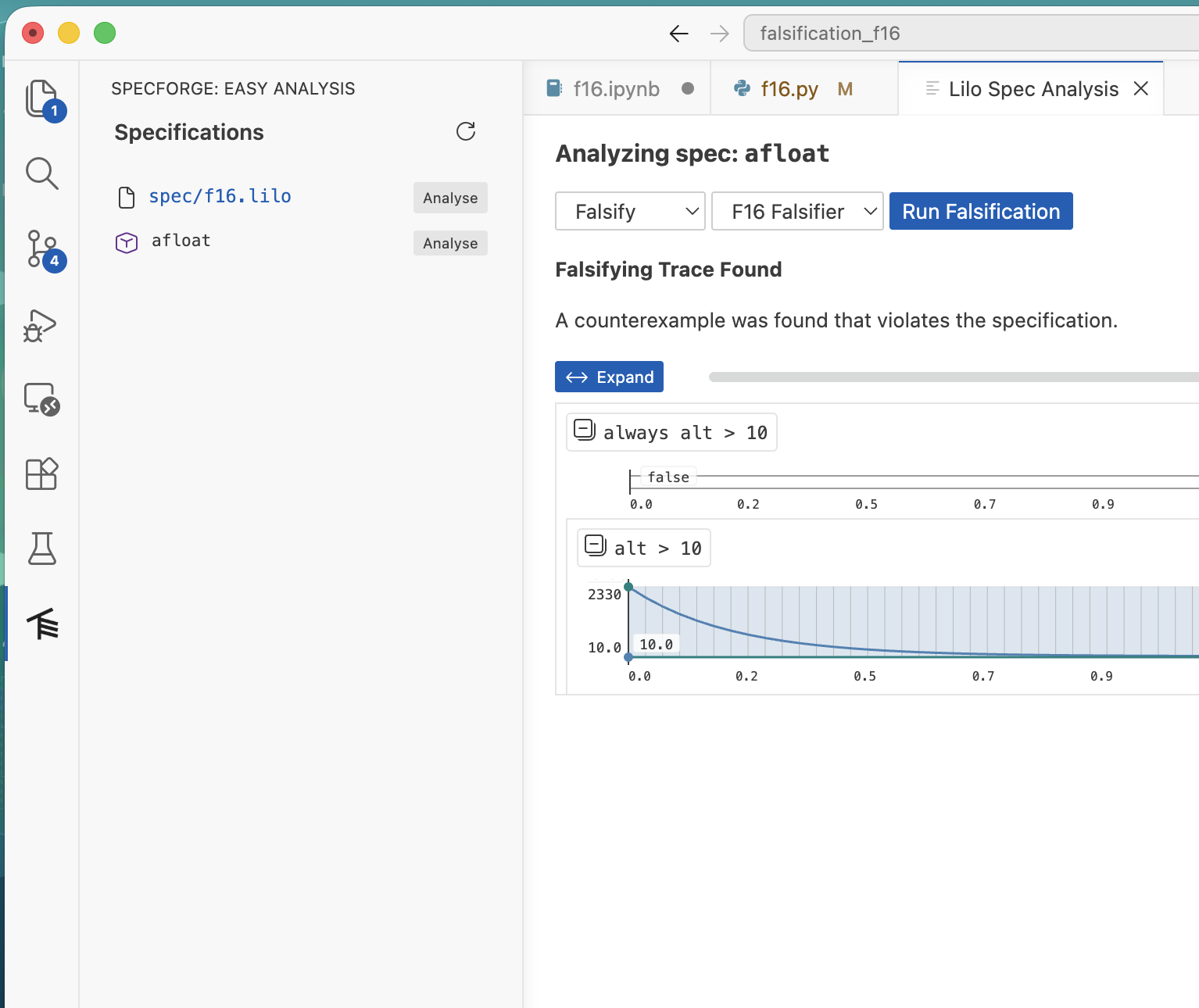
Online Monitoring
SpecForge can be used as an online monitor for Lilo specifications. In contrast with offline monitoring, this means that the monitor will produce verdicts in a streaming manner as it ingests the trace, rather than in one shot after processing the entire trace.
To invoke the online monitor, use the streammon command in the specforge CLI. Run specforge streammon --help for the exact arguments necessary. Running the specforge streammon command will start the monitor, which will ingest a trace from STDIN and produce an output signal to STDOUT.
The monitor accepts traces in CSV or JSONL format. In the case of CSV, the monitor expects the first line fed in to be the headers, which can be used to identify the columns corresponding to each signal. In the case of JSONL, the monitor expects each line to be a JSON object with keys corresponding to signal names. The user can specify whether records are encoded in flat or nested format using the RECORD_ENCODING subcommand (see the chapter on Data).
The current implementation of the online monitor performs best when the intervals in temporal operators extend to a small window into the future or past. Intervals with unbounded windows, even if past-time, are not supported.
Future-time temporal operators are supported in the online monitor. Their verdicts are produced with a delay corresponding to the largest future window in the spec. For example, when monitoring the formula eventually [0, 5] f, the monitor will produce the verdict for the current time t, only after ingesting the part of the trace upto time t + 5.
Export to RTAMT
SpecForge supports the export of specifications in Lilo to be used by third party monitoring tools. Currently, we only support RTAMT, a monitoring tool for Signal Temporal Logic (STL), maintained by Nickovic et al.
Invoking the Export Functionality
The export functionality can be invoked from the easy analysis UI in the SpecForge VSCode extension, as shown in the screenshot below.
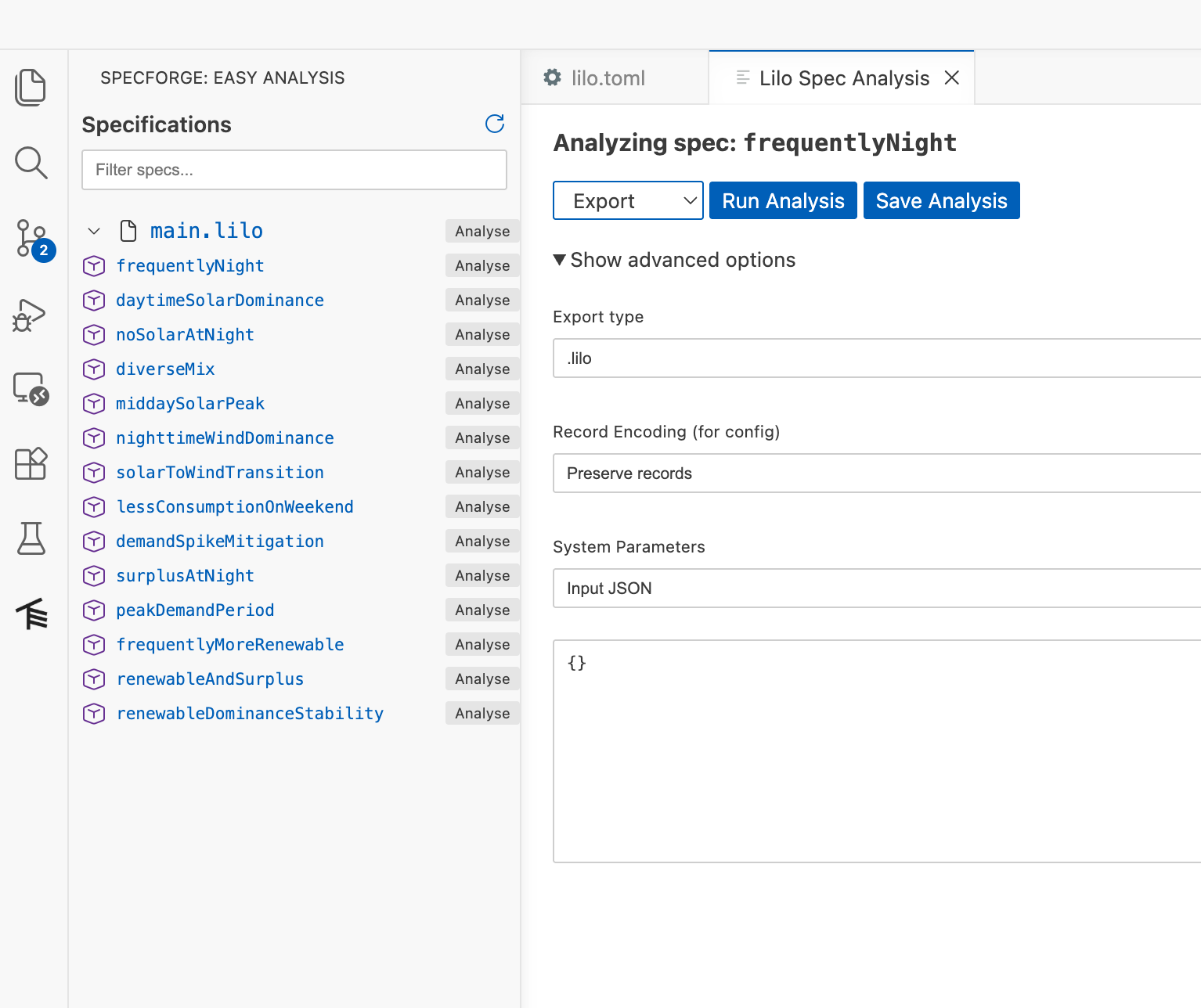
Alternatively, it can also be invoked using the Python SDK for use in a Python Script or a Jupyter Notebook. See the Python SDK documentation for the specifics of this method.
rtamt_formula = specforgeClient.export(
    system="f16",
    definition="afloat",
    export_type=EXPORT_RTAMT,
    return_string=True  # Get the exported string
)
print("Exported RTAMT formula:", rtamt_formula)
Further Notes on RTAMT
RTAMT is distributed as a Python library. We refer the user to the RTAMT documentation for instructions on how to install and use it.
When exporting to RTAMT, SpecForge will inline definitions to produce a single formula. Parameters will be replaced with their default values, or with values provided as an argument to the export. Those parameters for which no value is provided will be replaced with a free variable of the same name. If a parameter has a default value, but the user wishes to replace it with a free variable, they can set the parameter value to the JSON value null.
The RTAMT formulas involve a much smaller grammar, and therefore the export of Lilo specifications to RTAMT may be limited in some cases. Some of the features of Lilo that are not supported in RTAMT include: usage of strings and records, usage of the time variable, usage of non-trivial expressions in intervals, and uses of if, did_change, will_change, previous_with and next_with. In some cases, the export may still succeed if optimizations applied by SpecForge result in a formula that eliminates the unsupported features.
Sliding window quantitative operations max_future, min_future, max_past and min_past are translated to their temporal (eventually, past, always and historically) counterparts in RTAMT. This works because RTAMT runs in the robustness mode, and does not typecheck formulas.
VSCode Extension
The SpecForge VSCode extension provides a comprehensive development environment for writing and analyzing Lilo specifications. It combines language support, interactive analysis tools, and visualization capabilities in a unified interface.
See the VSCode extension installation guide to get setup.
Overview
The extension provides:
- Language Support: Syntax highlighting, type-checking, and autocompletion via a Language Server Protocol (LSP) implementation
- Diagnostics: Real-time checking for type errors, unused definitions, and optimization suggestions
- Code Lenses: Interactive analysis tools embedded directly in your code
- Spec Status Pane: A dedicated sidebar for navigating specifications and saved analyses
- Spec Analysis Pane: Interactive GUI for spec monitoring, exemplification, falsification, etc.
- Notebook Integration: Support for visualizing SpecForge results in Jupyter notebooks
- LLM Features: AI-powered spec generation and diagnostic explanations
Configuration
The extension requires the SpecForge server to be running. Configure the server connection in VSCode settings.
Server Connection
-
API Base URL (
specforge.apiBaseUrl): The base URL for the backend analysis server. This is ignored ifspawnServeris enabled. (string, default:http://localhost:8080) -
Spawn Server (
specforge.spawnServer): If enabled, the extension manages the SpecForge server process locally instead of connecting to an external server viaapiBaseUrl. (boolean, default:false) -
Server Path (
specforge.serverPath): The command or absolute path to the SpecForge binary. RequiresspawnServerto be enabled. (string, default:specforge) -
Preferred Port (
specforge.preferredPort): The preferred port for the locally spawned SpecForge server. The extension will attempt to use this port, but will fall back to another available port if it is already in use. RequiresspawnServerto be enabled. (integer between 1 and 65535, default:8080)
Server Tuning
These settings only apply when spawnServer is enabled.
-
Cache Bound (
specforge.cacheBound): The size of the LRU cache for SMT solver results. Leave blank for default. (integer or null, default:null) -
Semaphore Limit (
specforge.semaphoreLimit): The maximum number of concurrent SMT solver processes. Leave blank for default. (integer or null, default:null)
LLM Integration
These settings configure the AI features used for spec generation and diagnostic explanations. The provider and model settings only apply when spawnServer is enabled.
-
LLM Provider (
specforge.llmProvider): The LLM provider used for explanations and spec generations. Options:openai,anthropic,ollama,gemini,default. (string, default:default) -
LLM Model (
specforge.llmModel): The LLM model used for explanations and spec generations. Leave blank for default. (string, default:"") -
OpenAI API Key (
specforge.openAIApiKey): The API key for OpenAI. Leave blank to inherit from the environment, or if irrelevant. (string, default:"") -
Anthropic API Key (
specforge.anthropicApiKey): The API key for Anthropic. Leave blank to inherit from the environment, or if irrelevant. (string, default:"") -
Gemini API Key (
specforge.geminiApiKey): The API key for Gemini. Leave blank to inherit from the environment, or if irrelevant. (string, default:"") -
Ollama API Base (
specforge.ollamaApiBase): The API base URL for Ollama. Leave blank to inherit from the environment, or if irrelevant. (string, default:"")
Other Settings
-
Enable Preview Features (
specforge.enablePreviewFeatures): Enable experimental features that are not yet ready for release. (boolean, default:false) -
Trace Server (
specforge.trace.server): Traces the communication between VS Code and the language server. Useful for debugging extension issues. Options:off,messages,verbose. (string, default:off)
Initializing a New Project
You can initialize a directory with the recommended project structure from VSCode. Open the command palette (Ctrl+Shift+P / Cmd+Shift+P) and run SpecForge: Initialize SpecForge Project. This is equivalent to running the init CLI command.
This command will only work if specforge.spawnServer is enabled and specforge.serverPath is correctly configured, since it relies on the SpecForge binary.
We recommend that when working on a SpecForge project in VSCode, you open the project root directory as the sole workspace folder.
Language Features
Parsing and Type Checking
The extension performs real-time checking as you write specifications. Errors will be underlined. Hovering over the affected code will show the error:
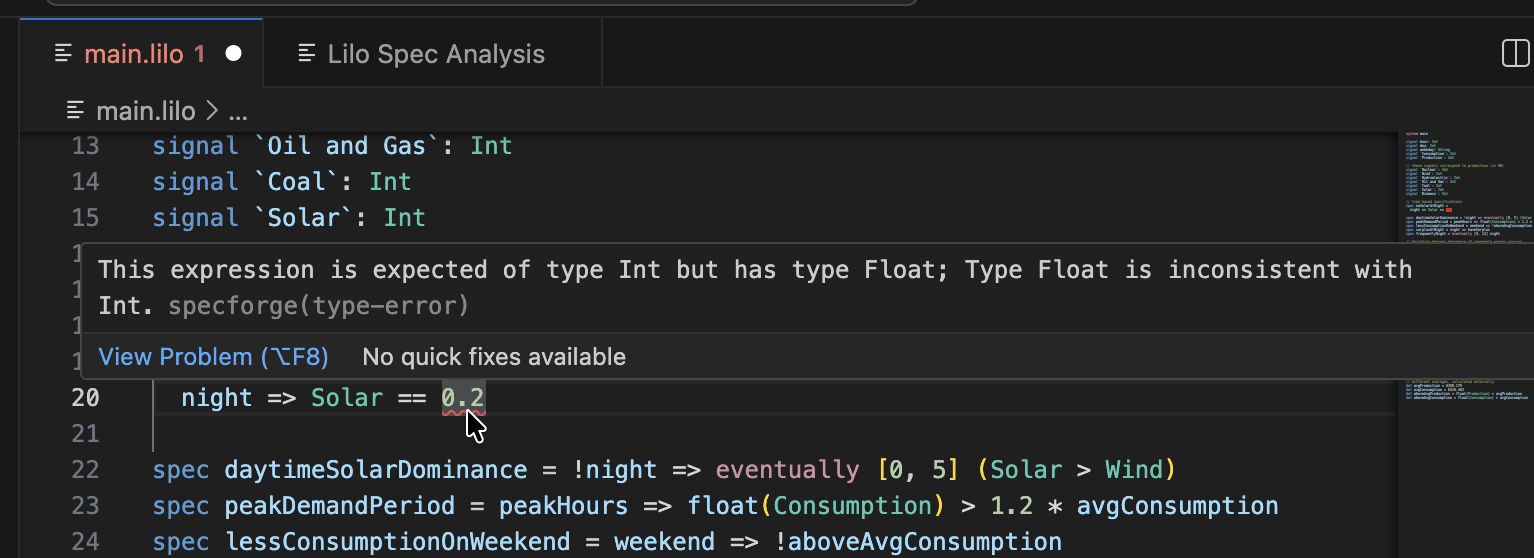
The extension will check for syntax errors, type errors, etc.
Document Outline
The extension provides a hierarchical outline of your specification file:
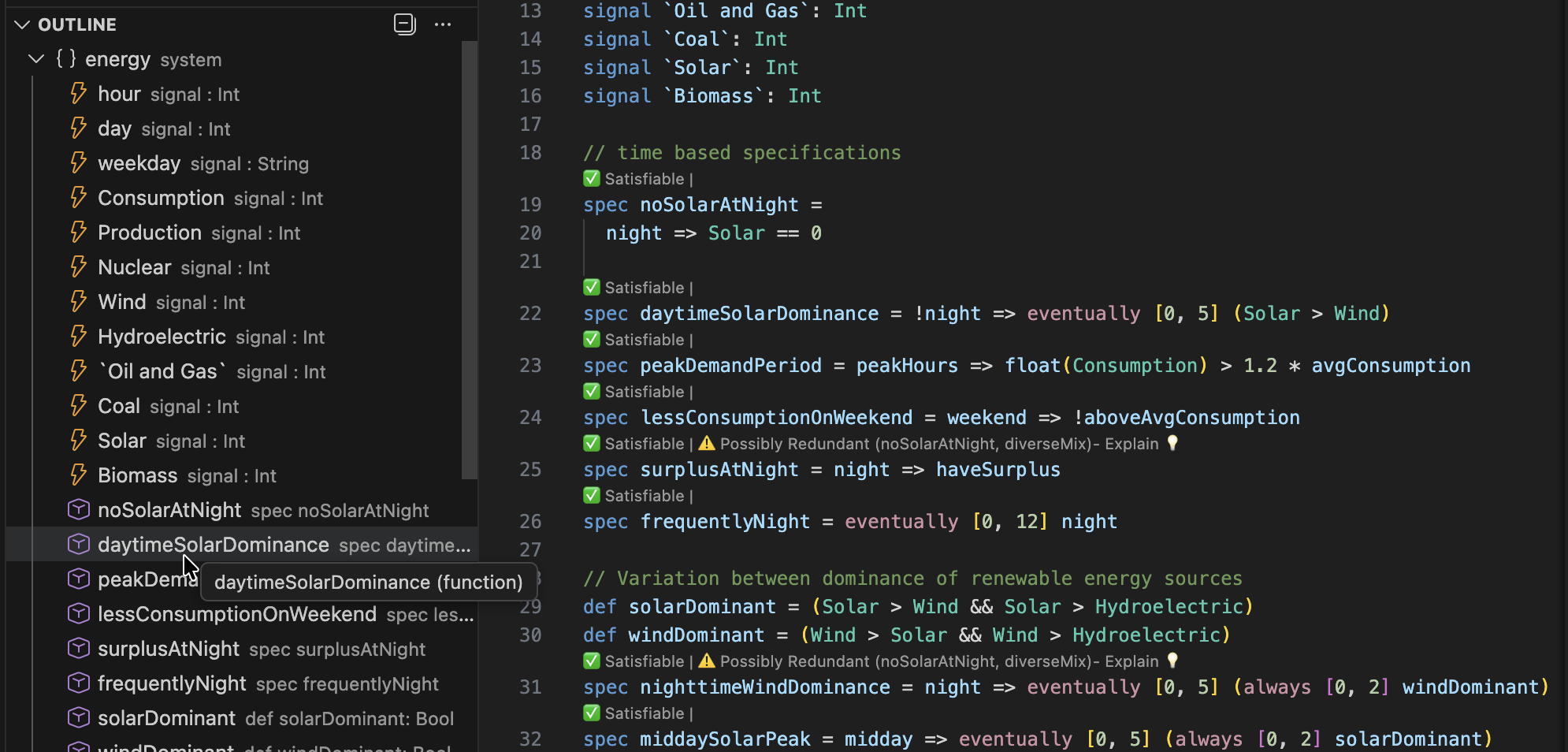
- Open the “Outline” view in VSCode’s Explorer sidebar
- See all specs, definitions, signals, and parameters at a glance
- Click any symbol to jump to its definition
- The outline updates automatically
Diagnostics
The extension performs various checks automatically and provides feedback.
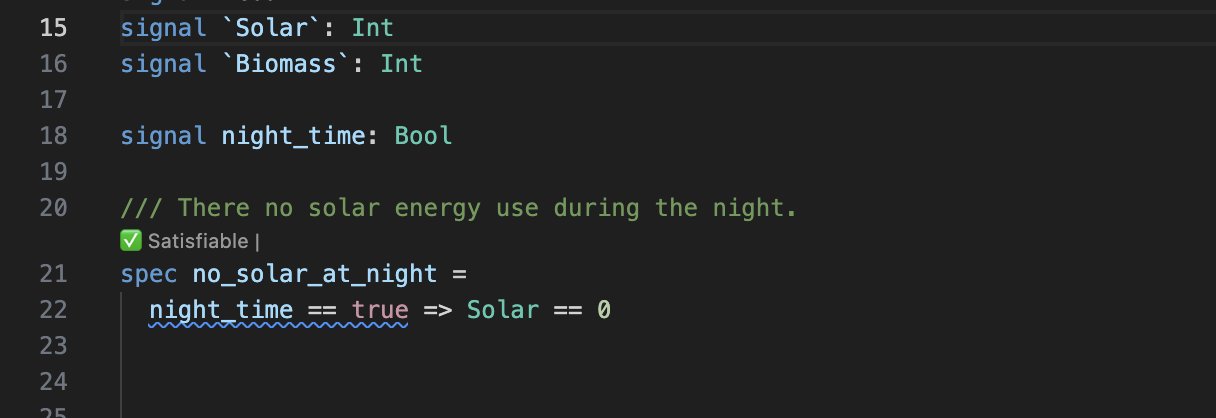
Hovering over a diagnostic will reveal the message.
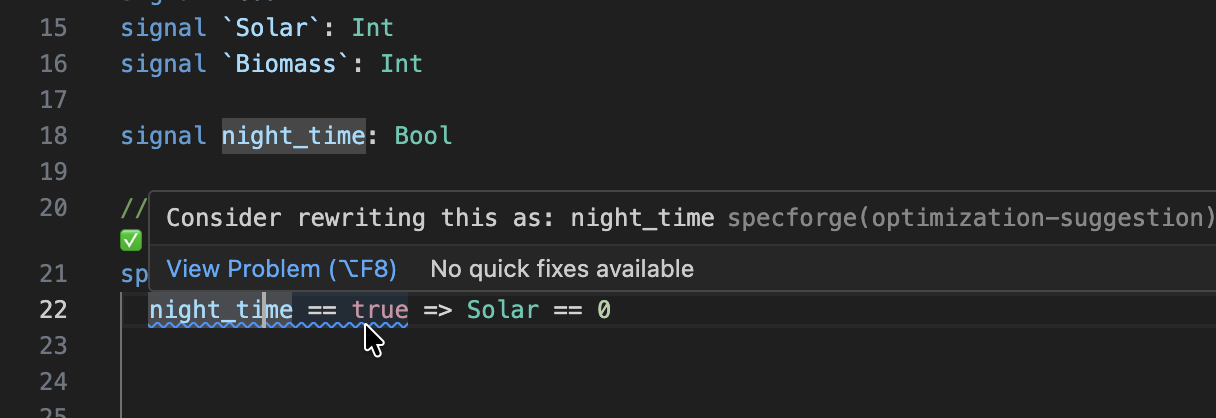
Diagnostics include:
- Warnings for unused
signals,params,defs, etc. - Optimization suggestions.
- Warnings about using time-dependent expression in intervals (if so configured).
Code Lenses
Code lenses are interactive buttons that appear above specifications in your code, offering information and possibly actions.
Satisfiability Checking
Above each specification, you’ll see a code lens indicating whether the spec is satisfiable:

When a spec is satisfiable, the “✅ Satisfiable” lens is clickable. Clicking it opens the Spec Analysis pane with the Exemplify analysis pre-selected for that spec, so you can immediately generate an example trace that witnesses the spec’s satisfiability.
Here is a spec that SpecForge has detected might be unsatisfiable:
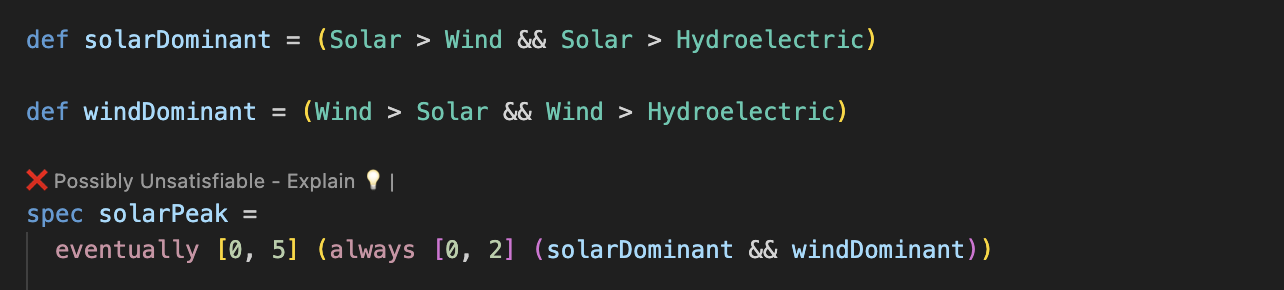
The user can ask for an explanation:
If SpecForge could not decide the satisfiability, it is possible to relaunch the analysis with a longer timeout.
Redundancy
If the system detects that a spec might be redundant, a warning is show as a code lens:

In this case, SpecForge is indicating that the spec is implied by the specifications noSolarAtNight and diverseMix, and is therefore not necessary. By clicking Explain, an explanation for the redundancy is produced:
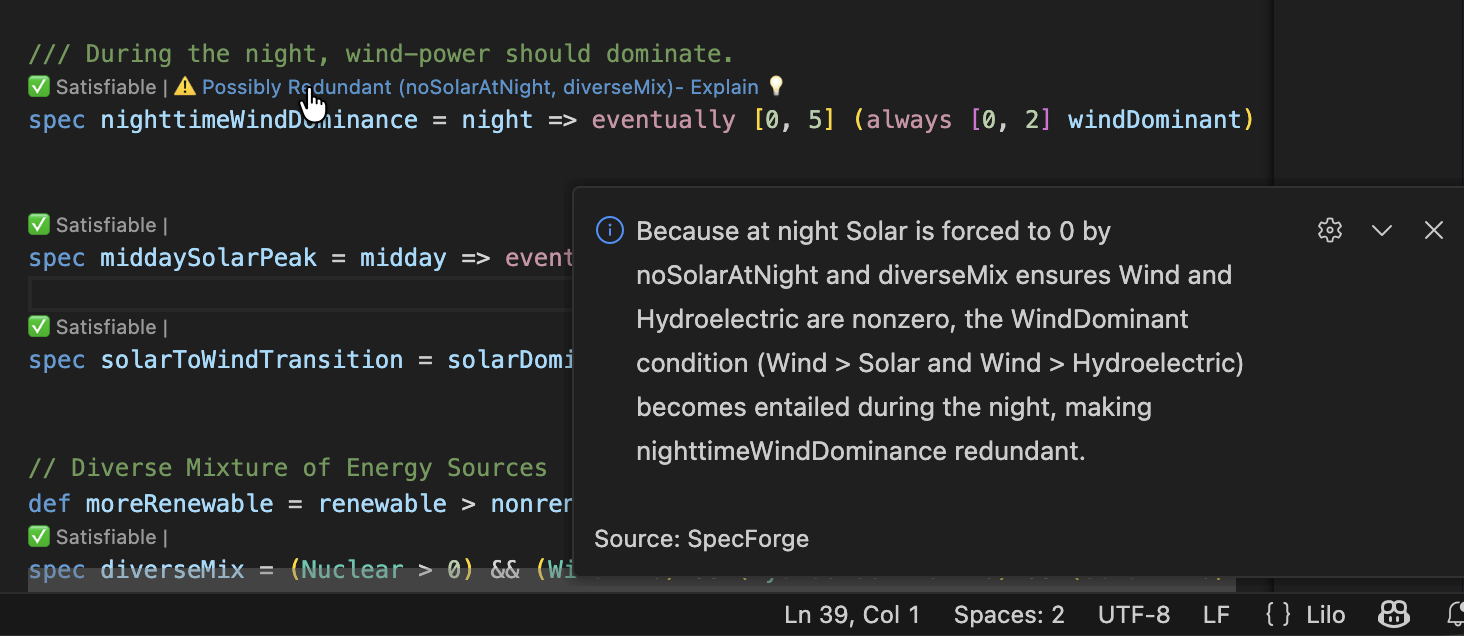
Stubs
If a spec or an assumptiondoes not have a body, it is called a stub. In this case a code lens offers to generate the specification using AI.

Clicking Generate with LLM will produce a definition for the specification, that works with the current system. If the spec is too ambiguous, or if there is some other obstacle to generation, an error message will be shown.
Spec Status Pane
To access the spec status panel, click the SpecForge icon on the left hand side of VSCode:
The sidebar lists all the specification files and the specs that are defined:
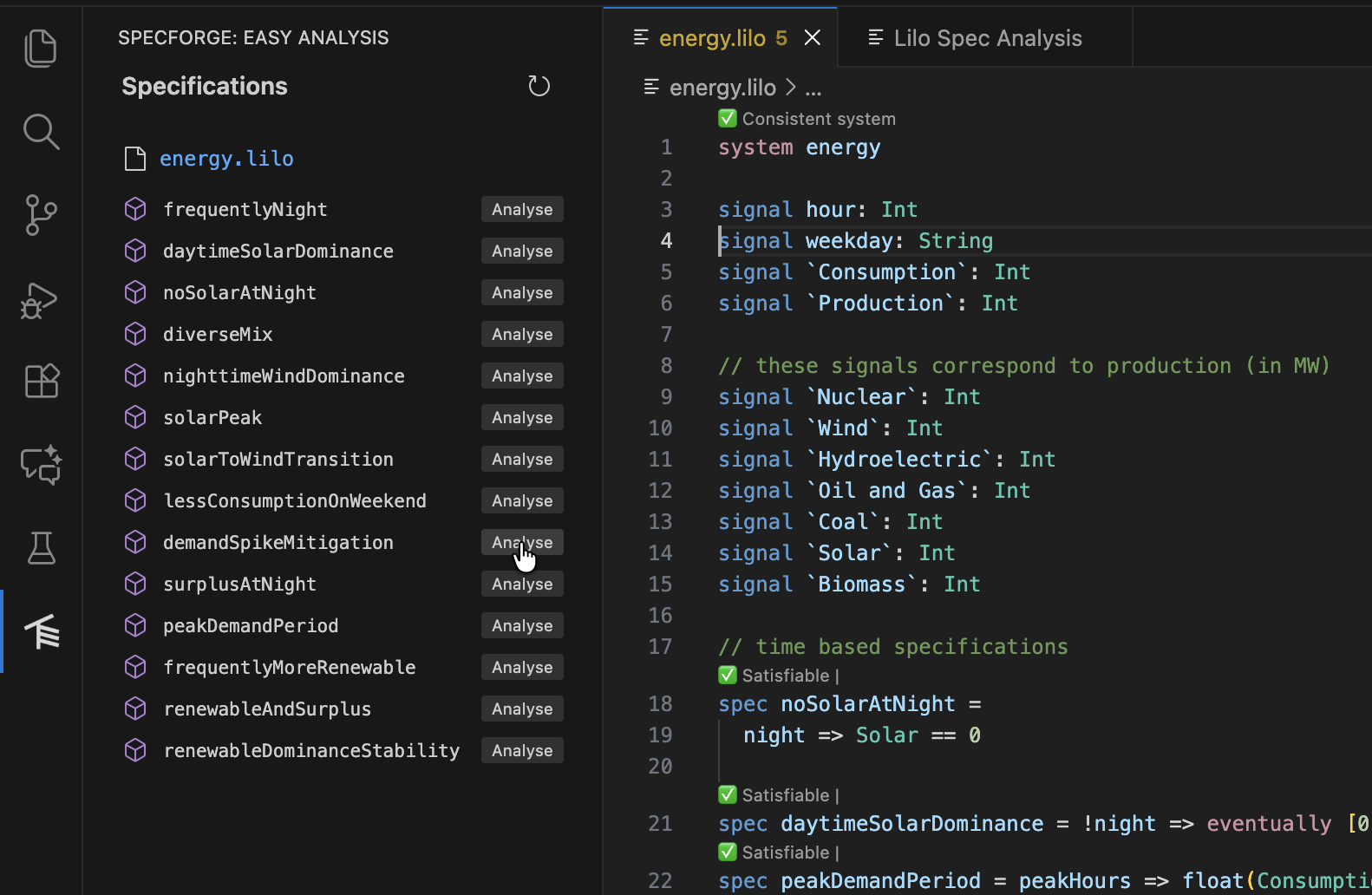
Clicking Analyze next to a spec will bring you to a spec analysis window. You can use this to launch various spec analysis tasks: monitoring, exemplification, export, animation and falsification.
Filtering and Query Syntax
The filter box in the Spec Status Pane can be used to narrow the visible specifications.
Unquoted text is treated as a fuzzy text search, while quoted text must produce an exact match. Both match against:
- the specification name
- docstrings
- aliases
For example, searching for pump or temperature limit will match specs whose names or metadata are close to those terms.
You can also filter by custom field using field:value syntax:
priority:>10 reviewed:true owner:"ops"
Custom-field predicates only apply to field names that actually exist in the current workspace. Supported comparison operators are: =, !=, <, <=, >, >=.
Examples:
priority:2priority:>=2reviewed:trueowner:"ops"
Multiple text terms and field predicates are combined with AND, so a specification must satisfy all of them to remain visible.
Label chips can also be toggled in the sidebar. Label selections are combined with OR across the selected labels, and then combined with the text query as an additional filter.
For example, to monitor a specification, select Monitor from the dropdown, and choose a data file to monitor, and click Run Analysis.
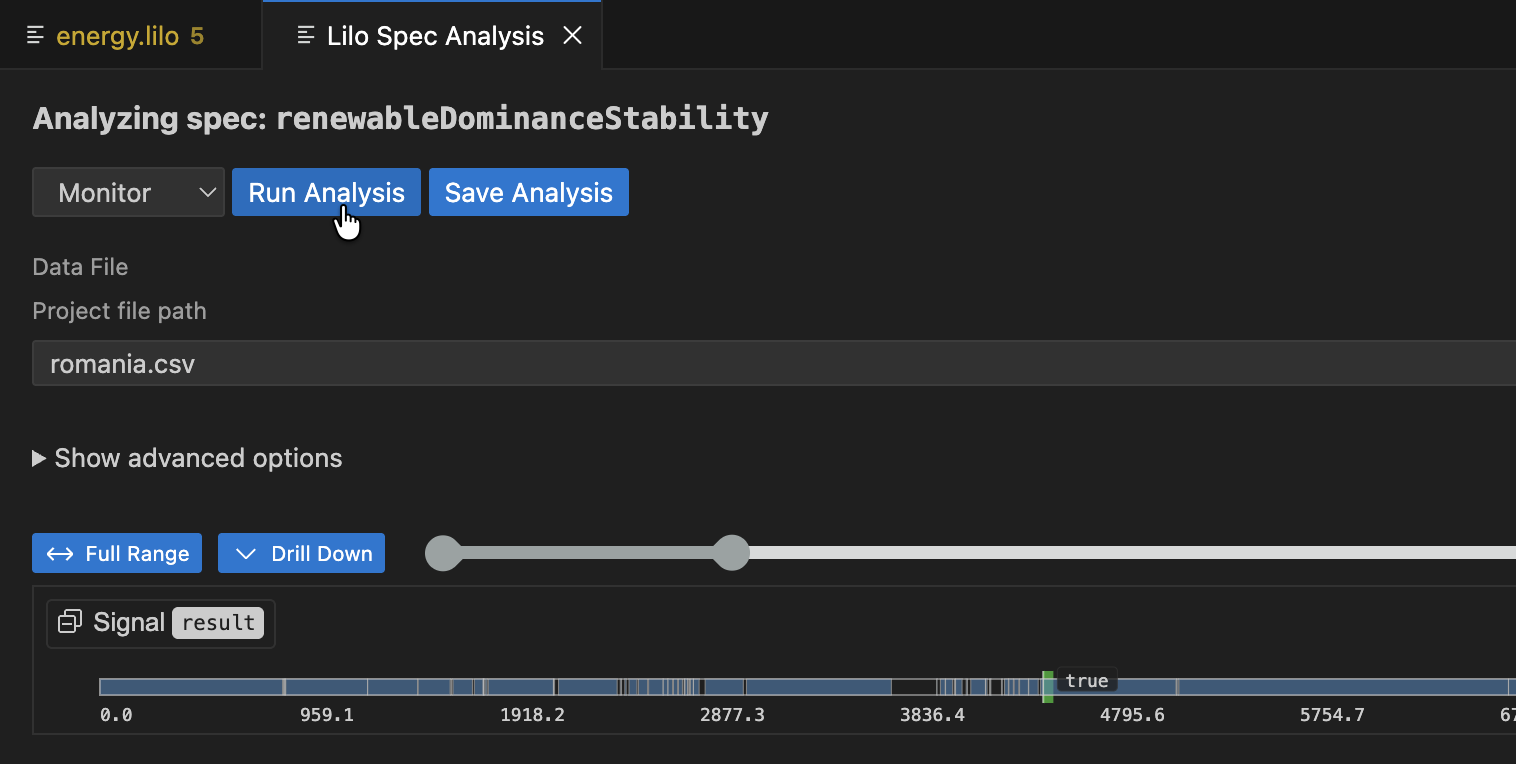
The result of the analysis is shown. The blue areas represent the times where the specification is true. For large data files, only the boolean result is shown. To better understand why a specification is false at some point, select a point and click Drill Down.
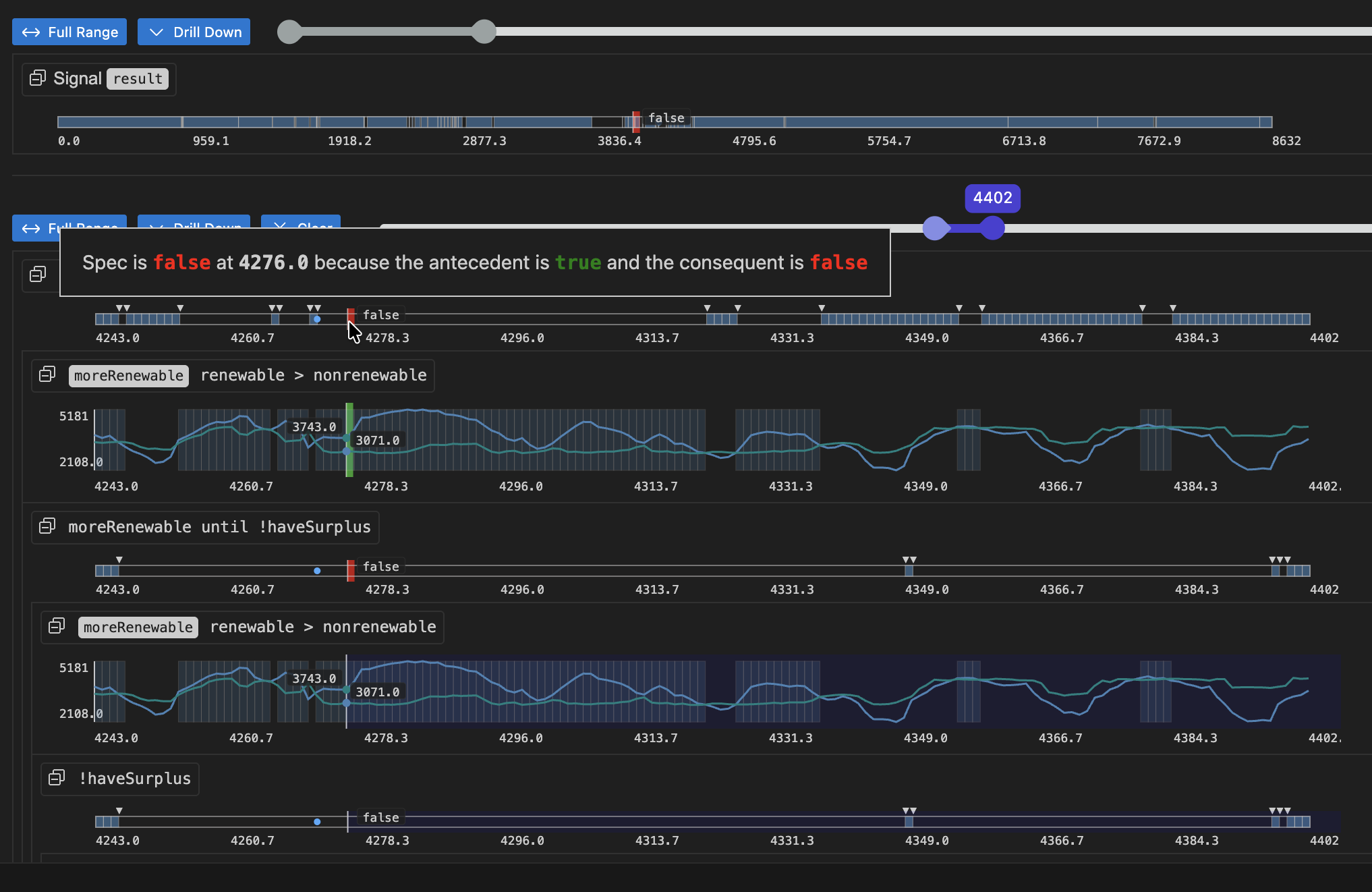
The drill-down has chosen a small enough segment of the full data source in order to present the debugging tree. This will show a tree of monitoring result for the whole specification. Each node can be collapsed or expanded. Hovering on the timeline will also highlight relevant regions in sub-expression result timelines. Hovering on a timeline will display an explanation of why the result is true or false at that point in time, for that sub-expression.
A spec analysis such as this can be saved by clicking on the Save Analysis button.
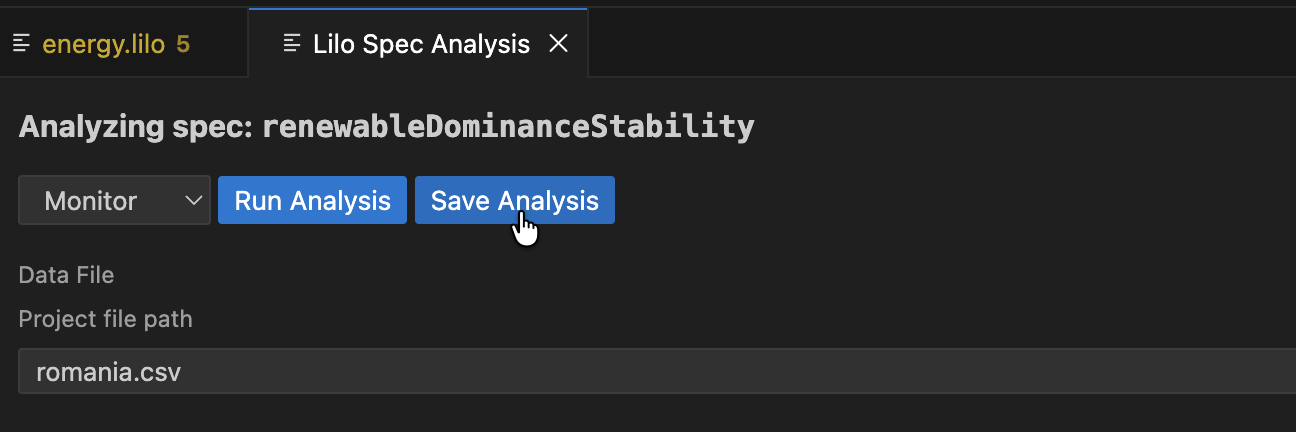
Choose a location in your project to save the analysis.
Saved analyses will show up in the spec status side panel, underneath the relevant spec.
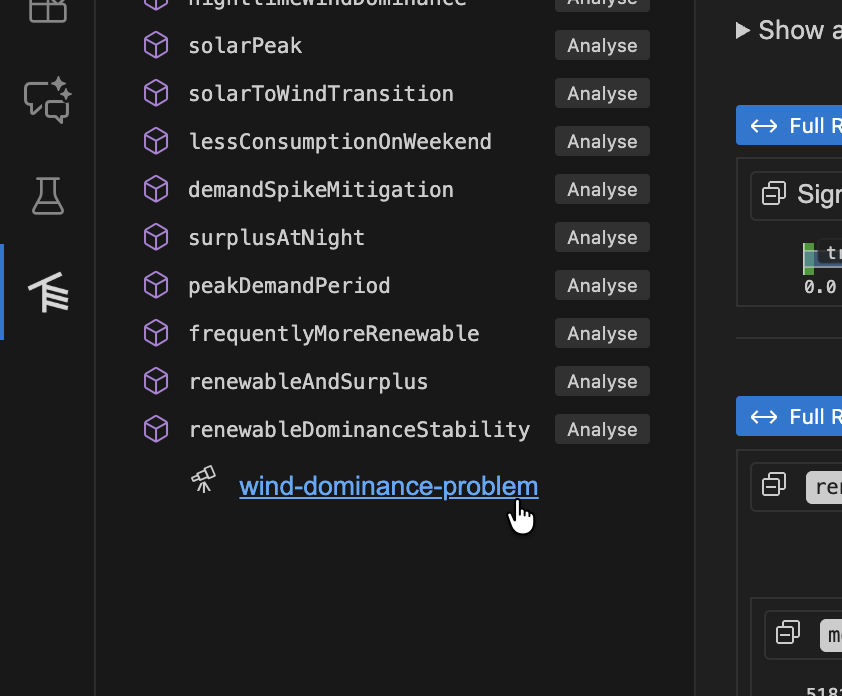
Analysis Types
The GUI supports five types of analysis:
1. Monitor
Check whether recorded system behavior satisfies your specification.
Inputs:
- Signal Data: CSV, JSON, or JSONL file containing time-series data
- CSV: Column headers must match signal names
- JSON/JSONL: Objects with keys matching signal names
- Parameters: JSON object with parameter values
- Options: Monitoring configuration (see Monitoring Options)
Output:
- Monitoring tree showing spec satisfaction over time
- Drill-down into sub-expressions
- Visualization of signal values
Example:
{
  "min_temperature": 10.0,
  "max_temperature": 30.0
}
2. Exemplify
Generate example traces that satisfy your specification.
Inputs:
- Number of Points: How many time time points to generate (default: 10)
- Timeout: Maximum time to spend generating (default: 5 seconds)
- Also Monitor: Whether to also show monitoring tree for the generated trace
- Assumptions: Additional constraints for the solver to satisfy, each with a rigidity level (Hard or Soft). See Exemplification and Satisfiability for details on assumptions and rigidity levels.
Output:
- Generated signal data as time-series
- Optional monitoring tree if “Also Monitor” is enabled
- CSV/JSON export of generated data
Use Cases:
- Understanding what valid behavior looks like
- Testing other components with realistic data
- Creating test fixtures
- Validating your specification makes sense
3. Falsify
Search for counterexamples that violate your specification using an external model.
Prerequisites:
- A falsification script must be registered in
lilo.toml:
[[system_falsifier]]
name = "Temperature Model"
system = "temperature_control"
script = "falsifiers/temperature.py"
Falsification Script Protocol:
Your script receives these command-line arguments:
--system: The system name--spec: The specification name--options: JSON string with options--params: JSON string with parameter values--project-dir: Path to the project root
The script should:
- Simulate the system according to the specification
- Search for a trace that violates the spec
- Output JSON in the correct format with either success or failure.
Inputs:
- Falsifier: Select from configured falsifiers (dropdown)
- Timeout: Maximum time for falsification (default: 240 seconds)
- Parameters: JSON object with parameter values
Output:
- If counterexample found:
- Falsification result showing the failing trace
- Automatic monitoring of the counterexample
- Visualization of where/how the spec fails
- If no counterexample found: Success message
Make sure your script is executable:
chmod +x falsifiers/temperature.py
4. Export
Convert your specification to other formats.
Export Formats:
- Lilo: Export as
.liloformat with optional transformations - JSON: Machine-readable JSON representation
Inputs:
- Export Type: Select the target format
- Parameters: Parameter values (if needed for export)
Output:
- Exported specification in the selected format
- Can be saved to a file
Use Cases:
- Integrating with other tools
- Documentation generation
- Archiving specifications
5. Animate
Create animations showing specification behavior over time.
Inputs:
- SVG Template: Path to SVG file with placeholders
- Signal Data: CSV, JSON, or JSONL file with time-series data
- System Parameters (optional): Parameter values for the system, provided as a JSON file or inline values. These supply values for
paramdeclarations in the Lilo system definition.
Output:
- Frame-by-frame SVG images showing system evolution
- Can be combined into an animated visualization
SVG Template Format:
Your SVG template should include data-attributes for signal values, e.g.:
<svg
  xmlns="http://www.w3.org/2000/svg"
  width="100"
  height="100"
  viewBox="0 0 40 40"
  role="img"
  aria-label="Transformed ball"
>
  <rect width="100%" height="100%" fill="white" />
  <g transform="translate(0,50) scale(1,-1)">
    <circle cx="20" data-cy="temperature" cy="0" r="3" fill="black" stroke="white" />
  </g>
</svg>
In this example, the <cicle> elements cy attribute will be animated by the value of the temperature signal, thanks to the data-cy="temperature" attribute.
Monitoring Options
When running Monitor or Falsify analyses, you can configure these options:
- Time Bounds: Restrict monitoring to a specific time range
- Sampling: Adjust temporal resolution
- Signal Filtering: Monitor only specific signals
- (Additional options may be available)
Working with Results
Monitoring Tree
The monitoring tree shows:
- Root: Overall spec result (true/false/unknown)
- Sub-expressions: Drill down into why the spec is true or false
- Timeline: Hover over any expression to see when it’s true/false
- Highlighting: Relevant segments are highlighted when hovering
Loading Saved Analyses
Open a saved .analysis.sf file to:
- See the original configuration
- Re-run the analysis with the same settings
- Modify parameters and run again
- Export results
The Analysis Editor provides the same interface as the main analysis GUI, but pre-populated with your saved configuration.
An analysis is a file, if you modify the analysis, you should save it.
Jupyter Notebook Integration
The extension includes a notebook renderer for displaying SpecForge results in Jupyter notebooks.
Activation
The renderer automatically activates for:
- Jupyter notebooks (
.ipynbfiles) - VSCode Interactive Python windows
Usage with Python SDK
When using the SpecForge Python SDK, results are automatically rendered:
from specforge import SpecForge

sf = SpecForge()
result = sf.monitor(
    spec_file="temperature_control.lilo",
    definition="always_in_bounds",
    data="sensor_logs.csv",
    params={"min_temperature": 10.0, "max_temperature": 30.0}
)

# result is automatically rendered in the notebook
result
Snippets
The extension provides Python code snippets for common SpecForge operations (monitor, exemplify, export). Type the snippet name and press Tab to insert and navigate through placeholders.
Troubleshooting
Extension Not Working
Check the SpecForge server:
- Ensure the server is running (see Setting up SpecForge)
- Verify the API base URL in settings matches your server
- Check the server logs for errors
Restart the language server:
- Run
SpecForge: Restart Language Serverfrom the command palette - Check the “Output” panel (View → Output) and select “SpecForge” from the dropdown
Diagnostics Not Appearing
Trigger a refresh:
- Save the file (Ctrl+S / Cmd+S)
- Close and reopen the file
- Restart the language server
Check server connection:
- Look at the status bar for connection status
- Verify the server is reachable at the configured URL
Code Lenses Not Showing
Check configuration:
- Ensure code lenses are enabled in VSCode:
Editor > Code Lens - Save the file to trigger code lens computation
Check for errors:
- Look for parse or type errors that prevent analysis
- Fix any red squiggles in your code
Analysis GUI Not Loading
Check webview:
- Open the Developer Tools:
Help > Toggle Developer Tools - Look for errors in the Console tab
- Check if the webview iframe loaded
Check server connection:
- Verify the API base URL is correct
- Test the URL in a browser (should show a JSON response)
Falsification Script Errors
Verify script setup:
- Check the script path in
lilo.toml - Ensure the script is executable:
chmod +x script.py - Test the script manually with example arguments
Check script output:
- The script must output valid JSON
- Use the correct result format (see Falsify)
- Check script logs for error messages
Common issues:
ENOENT: Script file not found (check path)EACCES: Script not executable (runchmod +x)- Parse error: Invalid JSON output (check script output format)
SpecForge Python SDK
The SpecForge python SDK is used for interacting with the SpecForge API, enabling formal specification monitoring, animation, export, and exemplification.
Refer to the Setting up the Python SDK guide for instructions on installing and configuring the SDK in a Python environment.
Quick Start
from specforge_sdk import SpecForgeClient

# Initialize client
specforge = SpecForgeClient(base_url="http://localhost:8080")

# Check API health
if specforge.health_check():
    print("✓ Connected to SpecForge API")
    print(f"API Version: {specforge.version()}")
else:
    print("✗ Cannot connect to SpecForge API")
Core Features
The SDK provides access to core SpecForge capabilities:
- Monitoring: Check specifications against data
- Satisfiability: Check whether a spec, inline expression, or whole system is satisfiable
- Validity: Check whether a spec or expression is provable under the system’s assumptions
- Equivalence: Check whether two specs or expressions are logically equivalent
- Animation: Create visualizations over time
- Export: Convert specifications to different formats
- Exemplification: Generate example data that satisfies specifications
Documentation
See the comprehensive demo notebook at sample-project/demo.ipynb for:
- Detailed usage examples
- Jupyter notebook integration
- Custom rendering features
API Methods
SpecForgeClient(base_url, ...)
Initialize a SpecForge API client.
Parameters:
base_url(str): The base URL of the SpecForge API server (default: “http://localhost:8080”)project_dir(str/Path): Optional project directory path; if not provided, searches up from current directory forlilo.tomltimeout(int): Request timeout in seconds (default: 30)check_version(bool): Whether to check for version mismatches on initialization (default: True)
Example:
specforge = SpecForgeClient(
    base_url="http://localhost:8080",
    project_dir="/path/to/project",
    timeout=60
)
monitor(system, definition, ...)
Monitor a specification against data. Returns analysis results with verdicts and optional robustness metrics.
Key Parameters:
system(str): The system containing the definitiondefinition(str | None): Name of the spec to monitor. IfNone, monitors all specs in the system at once (system-wide monitoring).data_file(str/Path): Path to data file (CSV, JSON, or JSONL)data(list/DataFrame): Direct data as list of dicts or pandas DataFrame- Note: Provide exactly one of
data_fileordata
- Note: Provide exactly one of
params_file(str/Path): Path to system parameters fileparams(dict): Direct system parameters as dictionary- Note: Provide at most one of
params_fileorparams
- Note: Provide at most one of
encoding(dict): Record encoding configurationverdicts(bool): Include verdict information (default: True)robustness(bool): Include robustness analysis (default: False)partial_data(bool): Allow monitoring even when the data does not cover all signals declared in the system (default: True). When enabled, signals that are missing from the data are treated as unknown rather than causing an error. Set toFalseto require that the data provides values for every signal.return_timeseries(bool): If True, return DataFrame; if False, display JSON (default: False)
When definition=None, the monitor evaluates every spec in the system against the provided data and returns a combined result. This is useful for getting a quick overview of which specs pass and which fail across the entire system.
Examples:
# Monitor with data file and params file
specforge.monitor(
    system="temperature_sensor",
    definition="always_in_bounds",
    data_file="sensor_data.csv",
    params_file="temperature_config.json"
)

# Monitor with data file and params dict
specforge.monitor(
    system="temperature_sensor",
    definition="always_in_bounds",
    data_file="sensor_data.csv",
    params={"min_temperature": 10.0, "max_temperature": 24.0}
)

# Monitor with DataFrame and get results as DataFrame
result_df = specforge.monitor(
    system="temperature_sensor",
    definition="temperature_in_bounds",
    data=synthetic_df,
    encoding=nested_encoding(),
    params={"min_temperature": 10.0, "max_temperature": 24.0},
    return_timeseries=True
)

# Monitor with robustness analysis
specforge.monitor(
    system="temperature_sensor",
    definition="temperature_in_bounds",
    data_file="sensor_data.csv",
    params={"min_temperature": 10.0, "max_temperature": 24.0},
    robustness=True
)
animate(system, svg_file, ...)
Create an animation from specification, data, and SVG template.
Key Parameters:
system(str): The system containing the animation definitionsvg_file(str/Path): Path to the SVG template filedata_file(str/Path): Path to data filedata(list/DataFrame): Direct data as list of dicts or pandas DataFrame- Note: Provide exactly one of
data_fileordata
- Note: Provide exactly one of
params_file(str/Path): Path to a JSON file containing system parameter valuesparams(dict): Direct system parameters as a dictionary- Note: Provide at most one of
params_fileorparams
- Note: Provide at most one of
encoding(dict): Record encoding configurationreturn_gif(bool): If True, returns base64-encoded GIF string (default: False)save_gif(str/Path): Optional path to save the GIF file
Examples:
# Display animation frames in Jupyter
specforge.animate(
    system="temperature_sensor",
    svg_file="temp.svg",
    data_file="sensor_data.csv"
)

# Save animation as GIF file
specforge.animate(
    system="scene",
    svg_file="scene.svg",
    data_file="scene.json",
    save_gif="output.gif"
)

# Get GIF data as base64 string
gif_data = specforge.animate(
    system="temperature_sensor",
    svg_file="temp.svg",
    data=synthetic_df,
    encoding=nested_encoding(),
    return_gif=True
)

# Animate with system parameters
specforge.animate(
    system="temperature_sensor",
    svg_file="temp.svg",
    data_file="sensor_data.csv",
    params={"temp_threshold": 25.0}
)

# Animate with parameters from file
specforge.animate(
    system="temperature_sensor",
    svg_file="temp.svg",
    data_file="sensor_data.csv",
    params_file="temperature_config.json",
    save_gif="output.gif"
)
export(system, definition, ...)
Export a specification to different formats (e.g., LILO format).
Key Parameters:
system(str): The system containing the definitiondefinition(str): Name of the spec to exportexport_type(dict): Export format configuration (defaults to LILO)- Use one of
EXPORT_LILO,EXPORT_JSON, orEXPORT_RTAMTdefined in the library
- Use one of
params_file(str/Path): Path to system parameters fileparams(dict): Direct system parameters as dictionary- Note: Provide at most one of
params_fileorparams
- Note: Provide at most one of
encoding(dict): Record encoding configurationreturn_string(bool): If True, return exported string; if False, display JSON (default: False)
Examples:
# Export to LILO format as string
lilo_result = specforge.export(
    system="temperature_sensor",
    definition="always_in_bounds",
    export_type=EXPORT_LILO,
    return_string=True
)
print(lilo_result)

# Export with params file
export_result = specforge.export(
    system="temperature_sensor",
    definition="always_in_bounds",
    export_type=EXPORT_LILO,
    params_file="temperature_config.json",
    return_string=True
)

# Export with params dict
export_result = specforge.export(
    system="temperature_sensor",
    definition="always_in_bounds",
    export_type=EXPORT_LILO,
    params={"min_temperature": 10.0, "max_temperature": 24.0},
    return_string=True
)

# Export to JSON format (display in Jupyter)
specforge.export(
    system="temperature_sensor",
    definition="humidity_correlation",
    export_type=EXPORT_JSON
)
check_satisfiability(system, definition=None, expression=None, ...)
Check satisfiability of a single spec, an inline expression, or the whole system.
Key Parameters:
system(str): The system containing the definition(s)definition(str | None): Name of the spec to checkexpression(str | None): Inline Lilo boolean expression to check in the given system context- Note: Provide at most one of
definitionorexpression
- Note: Provide at most one of
- If both
definitionandexpressionareNone, the SDK checks the whole system timeout(int | float): Timeout in seconds for the satisfiability query (default: 30)return_details(bool): IfTrue, return the structured satisfiability response instead of a bool (default:False)
Returns:
-
bool:Truewhen satisfiable,Falseotherwise. -
If
return_details=True, returns a dictionary with two keys:"status": The satisfiability outcome. Checkresult["status"]["tag"]for one of:"Consistent"– the spec is satisfiable."InConsistent"– the spec is unsatisfiable. The"contents"field contains anUnsatInfoobject with details about the unsat core."Unknown"– the solver could not determine satisfiability."TimedOut"– the solver timed out. The"contents"field contains the timeout duration in microseconds.
"param_situation": Describes how system parameters (paramdeclarations) were handled during the check:"UsingDefaults"– the solver fixed all parameters to their declared default values and found the result with those defaults. This is the first strategy attempted."UnfixedParams"– the solver left all parameters free (unconstrained). This happens when the check with default values did not yield a"Consistent"result, so the solver retried with parameters as free variables.
The meaningful combinations of
statusandparam_situationare:- (
"Consistent","UsingDefaults") – the spec is satisfiable when the parameters are fixed to their declared defaults. - (
"Consistent","UnfixedParams") – the spec is satisfiable, but not when the parameters are fixed to their declared defaults. - (
"InConsistent","UnfixedParams") – for all possible values of the parameters, the spec remains unsatisfiable.
Examples:
# Check a single spec
is_satisfiable = specforge.check_satisfiability(
    system="temperature_sensor",
    definition="always_in_bounds"
)
print(is_satisfiable)

# Get the detailed response to inspect the param situation
details = specforge.check_satisfiability(
    system="temperature_sensor",
    definition="always_in_bounds",
    return_details=True
)
print(details["status"]["tag"])        # e.g. "Consistent"
print(details["param_situation"])      # e.g. "UsingDefaults" or "UnfixedParams"

# Check the whole system as a bool
system_is_satisfiable = specforge.check_satisfiability(
    system="temperature_sensor"
)
print(system_is_satisfiable)

# Check an inline expression in the system context
expr_is_satisfiable = specforge.check_satisfiability(
    system="temperature_sensor",
    expression="always (min_temperature <= temperature <= max_temperature)"
)
print(expr_is_satisfiable)
check_validity(system, definition=None, expression=None, ...)
Check validity of a single spec or an inline expression under the system’s assumptions.
Key Parameters:
system(str): The system containing the definition or in whose context the expression is parseddefinition(str | None): Name of the spec to proveexpression(str | None): Inline Lilo boolean expression to prove in the given system context- Note: Provide exactly one of
definitionorexpression
- Note: Provide exactly one of
timeout(int | float): Timeout in seconds for the validity query (default: 30)return_details(bool): IfTrue, return the structured validity response instead of a bool (default:False)
Returns:
bool:Truewhen the target is valid,Falseotherwise.- If
return_details=True, returns the structured validity result from the SpecForge API. Checkresult["status"]["tag"]for the outcome andresult["param_situation"]for how defaulted parameters were handled.
Examples:
# Check a single spec
is_valid = specforge.check_validity(
    system="temperature_sensor",
    definition="always_in_bounds"
)
print(is_valid)

# Check an inline expression in the system context
expr_is_valid = specforge.check_validity(
    system="temperature_sensor",
    expression="always (min_temperature <= temperature <= max_temperature)"
)
print(expr_is_valid)

# Get the detailed response when you need it
details = specforge.check_validity(
    system="temperature_sensor",
    definition="always_in_bounds",
    return_details=True
)
print(details["status"]["tag"], details["param_situation"])
check_equivalence(system, left, right, ...)
Check whether two specs or inline expressions are logically equivalent under the system’s assumptions.
Key Parameters:
system(str): The system in whose context both sides are parsedleft(str): First spec name or inline Lilo expressionright(str): Second spec name or inline Lilo expressiontimeout(int | float): Timeout in seconds (default: 30)return_details(bool): IfTrue, return the structured equivalence response instead of a bool (default:False)
Returns:
bool:Truewhen the two targets are equivalent,Falseotherwise.- If
return_details=True, returns the structured equivalence result from the SpecForge API. Checkresult["status"]["tag"]for the outcome andresult["param_situation"]for how defaulted parameters were handled.
Examples:
# Check that two formulations agree
are_equivalent = specforge.check_equivalence(
    system="temperature_sensor",
    left="always_in_bounds",
    right="always (min_temperature <= temperature <= max_temperature)"
)
print(are_equivalent)

# Mix of inline expressions
are_equivalent = specforge.check_equivalence(
    system="temperature_sensor",
    left="x > 0 && y > 0",
    right="y > 0 && x > 0"
)
print(are_equivalent)

# Get the detailed response
details = specforge.check_equivalence(
    system="temperature_sensor",
    left="always_in_bounds",
    right="always (min_temperature <= temperature <= max_temperature)",
    return_details=True
)
print(details["status"]["tag"], details["param_situation"])
exemplify(system, definition, ...)
Generate example data that satisfies a specification.
Key Parameters:
system(str): The system containing the definitiondefinition(str): Name of the spec to exemplifyassumptions(list): Additional assumptions to constrain generation (default: []). Each assumption is a dictionary with:"expression"(str): A Lilo boolean expression (or the name of an existing spec/def) to assume during generation."rigidity"(str): Either"Hard"or"Soft". See Rigidity Levels below.
n_points(int): Number of data points to generate (default: 10)params_file(str/Path): Path to system parameters fileparams(dict): Direct system parameters as dictionary- Note: Provide at most one of
params_fileorparams
- Note: Provide at most one of
params_encoding(dict): Record encoding for the parameterstimeout(int): Timeout in seconds for exemplification (default: 30)also_monitor(bool): Whether to also monitor the generated data (default: True)at_beginning(bool): If True (the default), the exemplifier searches for a trace whose first time point already satisfies the spec. If False, the spec may only become satisfied at a later point in the generated trace. Setting this toTrueis useful when you want the generated example to demonstrate satisfaction from the start; setting it toFalsegives the solver more freedom and can help when the spec involves temporal operators likepastthat are naturally satisfied later in the trace.fix_defaults(bool): Defaults toTrue. WhenTrue, the exemplifier is forced to fix any params with default values to those defaults. WhenFalse, the exemplifier ignores default values and treats params as free variables. See Fixing Params to Default Values for more details.return_timeseries(bool): If True, return DataFrame; if False, display JSON (default: False)
Rigidity Levels
Each assumption has a rigidity level ("Hard" or "Soft") that controls whether the solver treats it as an inviolable constraint or a preference. See Exemplification and Satisfiability for a full explanation.
Examples:
# Generate an example with 20 samples
specforge.exemplify(
    system="temperature_sensor",
    definition="always_in_bounds",
    n_points=20
)

# Generate example with a hard assumption
humidity_assumption = {
    "expression": "eventually (humidity > 25)",
    "rigidity": "Hard"
}
specforge.exemplify(
    system="temperature_sensor",
    definition="humidity_correlation",
    assumptions=[humidity_assumption],
    n_points=20
)

# Mix hard and soft assumptions
specforge.exemplify(
    system="temperature_sensor",
    definition="humidity_correlation",
    assumptions=[
        {"expression": "always_in_bounds", "rigidity": "Hard"},
        {"expression": "eventually (temperature > 30)", "rigidity": "Soft"}
    ],
    params={"min_temperature": 10.0, "max_temperature": 40.0},
    n_points=20
)

# Generate example with partial params (solver fills in missing values)
specforge.exemplify(
    system="temperature_sensor",
    definition="humidity_correlation",
    assumptions=[{"expression": "always_in_bounds", "rigidity": "Hard"}],
    params={"min_temperature": 38.0},
    n_points=20
)

# Allow the spec to be satisfied later in the trace (not necessarily at the first point)
specforge.exemplify(
    system="temperature_sensor",
    definition="recovery_spec",
    n_points=20,
    at_beginning=False
)

# Generate example and get as DataFrame
example_df = specforge.exemplify(
    system="temperature_sensor",
    definition="temperature_in_bounds",
    n_points=15,
    also_monitor=False,
    return_timeseries=True
)
list_defs(system, specs_only=False)
List all the definitions in the given lilo system.
Parameters:
system(str): The lilo system to list definitions fromspecs_only(bool): If True, only list specifications, not other definitions (default: False)
Returns: list of str - List of definition names
Example:
>>> specforgeClient.list_defs(system ='temperature_sensor', specs_only=True)
['temperature_in_bounds',
 'humidity_correlation',
 'emergency_condition',
 'recovery_spec',
 'always_in_bounds']
health_check()
Check if the SpecForge API is available and responding.
Returns: bool - True if API is healthy, False otherwise
Example:
if specforge.health_check():
    print("✓ Connected to SpecForge API")
else:
    print("✗ Cannot connect to SpecForge API")
version()
Get the API server version and SDK version.
Returns: dict with keys "api" and "sdk"
Example:
versions = specforge.version()
print(f"API Version: {versions['api']}")
print(f"SDK Version: {versions['sdk']}")
File Format Support
- Specifications:
.lilofiles - Data:
.csv,.json,.jsonlfiles - Visualizations:
.svgfiles
Requirements
- Python 3.12+
requests>=2.25.0urllib3>=1.26.0
Command Line Interface
The CLI is self-documenting. Run specforge --help to see all available commands, and specforge <command> --help for detailed usage of any command.
$ specforge --help
Usage: specforge COMMAND [--verbose VERBOSITY]

Available commands:
  parse       Check if the Lilo files in a project parse correctly.
  check       Typecheck the Lilo files in a project.
  format      Format the Lilo files in a project.
  monitor     Monitor a spec on a data file, producing an output signal.
  eval        Evaluate a spec at the first timestamp of a data file.
  streammon   Monitor a spec in streaming mode from standard input.
  export      Export a spec to another formalism (Lilo, JSON, RTAMT).
  schema      Generate a schema or data template for a system.
  init        Initialize a new Lilo project.
  flatten     Flatten hierarchical components in a system.
  serve       Start the SpecForge server (for the VS Code extension / Python SDK).
Record encoding
Several commands accept a RECORD_ENCODING subcommand (flat or nested) that controls how record-typed signals and parameters are represented. The flat encoding accepts -s / --separator SEPARATOR to set the field separator (default: "_").
When no encoding is specified, the default depends on the file format: flat for CSV, nested for JSON/JSONL.
See Record encoding in the Data Files chapter for a full explanation with examples.
Troubleshooting Guide
Running the Doctor
To diagnose issues such as connectivity with the SMT Solver (used for static analysis) or access to LLMs, you can run the doctor CLI command. Simply run specforge doctor --help to learn more.
Bypassing Proxies
When creating a SpecForge client object using the Python SDK (see the Python SDK guide), make sure that you have specified the correct base_url for the server. If you are running the server locally, make sure that you have specified the correct port.
On some systems, there may be a proxy configured which intercepts requests from the Jupyter Notebook (or other Python environments) to the SpecForge server. To ensure that the requests from the Python SDK bypass the proxy, try setting the NO_PROXY environment variable to include the address of the SpecForge server (usually localhost).
import os

os.environ["NO_PROXY"] = "localhost,127.0.0.1,::1,[::1]"
Changelog
All notable changes will be documented here. The format is based on Keep a Changelog. Lilo adheres to Semantic Versioning.
v0.5.4 - 2025-11-20
Added
- Local signal file monitoring.
- Offline licensing for Docker.
- Monitoring drill-down.
- Monitoring point of interest.
- VSCode Extension documentation.
- Public Docker image available on GHCR with accompanying docs.
- Analysis sidebar now auto-refreshes and shows a spinner while analysis runs.
Change
- Monitor tree sample limit increased to 3100.
- Spec status is no longer a preview feature.
Fixed
- Monitor tree range made responsive.
- Styles of the VSCode sidebar.
- Sample projects for monitoring are bundled correctly.
- Local signal file UX issues resolved.
v0.5.3 - 2025-11-14
Added
- A Whirlwind Tour guide.
- Offline licenses for SpecForge.
- Automated downsampling for monitoring.
- Gemini and Ollama LLM provider support.
- CLI monitoring commands gained interval and sampling options.
- Falsification examples added to the docs.
Fixed
- Issue with stale falsifier list.
- Module name mismatch error reported location.
- CLI commands now run from the project directory.
v0.5.2 - 2025-11-10
Changed
- Falsification timeout from 60 to 240 seconds.
Fixed
- Errors being reported in multiple files.
v0.5.1 - 2025-11-05
Added
- New documentation site: https://docs.imiron.io/.
- You can now create animation gif animations.
- Projects are setup with a
lilo.tomlfile, see Project Configuration. - Registration of system falsifiers in
lilo.toml. - VSCode spec status now lists analysis.
- Spec analysis in VSCode.
- Run falsification engines from the spec analysis pane.
Changed
- Better type errors for conflicting record construction/update.
- LLM explanations are localised according to user’s VSCode settings.
- Unbound variable errors now include a list of in-scope variables with similar spellings.
- System globals (
signals andparams) can have attributes, including docstrings. - The command JSON format has changed significantly, as is expected to be stable (backwards compatible) going forwards. In particular this uses system names, not filenames.
- One can specify a param as
null(JSON) to remove the default param values. - LLM spec generation will fail for under-specified specifications.
- CLI interface is updated to work with modules.
v0.5.0 - 2025-10-14
Added
- Default
params:param foo: Float = 42sets42as the default value of parameterfoo. - Timeout attributes:
will set the timeout to 3 seconds for analysis tasks on spec#[timeout = 3] spec foo = ...foo. - Warning for mismatched server/client versions.
- Spec stubs:
creates a “spec stub” (an unimplemented spec). There is also a code action to suggest an implementation using the docstring, using AI.spec no_overheat - Retry analysis with longer timeout: if an analysis times out, there is a code action to retry with a longer timeout.
- Record features:
- Record update (including deep)
- Field punning.
- Path construction and path update.
- Warnings for unused
defs,signals andparams. - Code hierarchy in VSCode.
- Modules: User can create modules (containing only
defandtypedeclarations), and import them.
Changed
- VSCode code lenses resolve one at a time, which results in a much more responsive experience.